Choosing the right rust converter can extend the life of steel, iron, and other metal surfaces by transforming rust into a stable, paint-ready coating. This guide highlights five top options and explains how to match features with project needs—whether you’re restoring vehicles, fencing, trailers, or industrial equipment. Each product section provides a quick look at coverage, application methods, and long-term protection, helping you make an informed purchase.
| Product | Brand | Size | Key Benefit |
|---|---|---|---|
| Seymour 16-45 Rust Converter | Seymour | Various | Penetrates rust and forms a protective black coating |
| Corroseal-82320 Water-Based Rust Converter | Corroseal | 1 Qt | One-step rust converter and primer with anti-corrosion seal |
| DWIL Rust Converter Paint & Primer | DWIL | 32 oz | 2-in-1 rust converter and primer for fast prep |
| Rust Kutter Stops Rust | Rust Kutter | 1 Gallon | Stable black coating and ready-to-paint finish |
| Corroseal Rust Converter & Metal Primer (1 Gallon) | Corroseal | 1 Gallon | One-step rust conversion and primer with broad coverage |
Seymour 16-45 Rust Converter

Seymour’s 16-45 Rust Converter is designed to penetrate rust and transform it into a protective black coating. This product is marketed for use on vehicles, trailers, fences, railings, sheet metal, and storage tanks, making it a versatile choice for both large outdoor projects and smaller repairs. The formulation aims to halt rust growth and create a foundation that resists future corrosion. Application can typically proceed without extensive surfacePrep in many cases, but test patches are advised to ensure adhesion and finish quality. The resulting coating serves as a base for subsequent topcoats, reducing additional steps in the restoration workflow.
Corroseal-82320 Water-Based Rust Converter

Corroseal-82320 pairs a rust-converting action with an integrated primer function in one step. This water-based formula is designed to convert rust and prime metal surfaces without grinding or sanding, helping to stop rust and prevent future corrosion. It’s described as easy to brush, roll, or spray on, with a milky white appearance that dries to black. The product is noted for low odor and non-flammability, with cleanup achievable using soap and water. Coverage is around 60-63 square feet per quart, making it suitable for mid-sized projects like trailers, gates, and farm equipment.
DWIL Rust Converter Paint & Primer
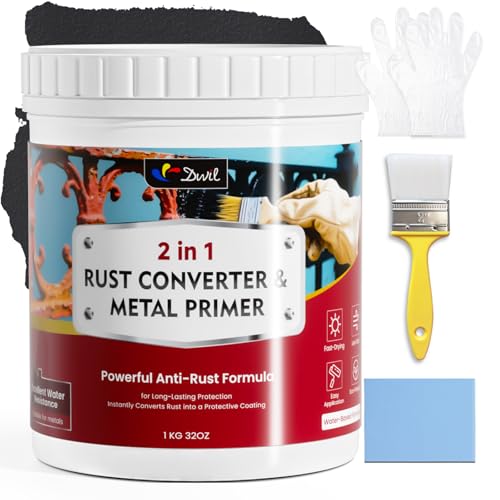
DWIL offers a 2-in-1 rust converter and primer designed for fast and efficient surface prep. The product claims to convert rust to a durable black protective coating without sanding, providing a ready-to-paint surface. It’s positioned for use on auto parts, tools, fences, and other outdoor metal where moisture and weather exposure are concerns. By serving as both reformer and primer, DWIL aims to simplify workflows and reduce labor time, especially on projects with limited access for sanding or traditional prep.
Rust Kutter Stops Rust
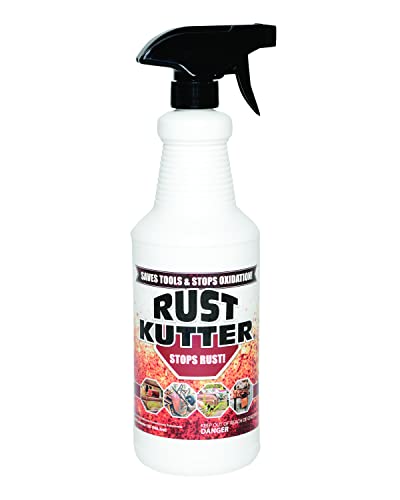
Rust Kutter focuses on stopping rust and converting spots to a primed surface ready for paint. This product is highlighted for professional rust repair and is manufactured in the USA with a sprayer included in some configurations. Its mechanism centers on a chemical reaction that transforms rust into a stable, paint-ready layer, simplifying repairs on automotive frames, fences, and outdoor metal. The inclusion of a sprayer adds convenience for larger exterior applications, where even coverage is crucial for durable results.
Corroseal Rust Converter & Metal Primer (1 Gallon)

This Corroseal product combines rust conversion with primer in a single gallon, making it suitable for larger jobs that require durable protection across trucks, trailers, and industrial equipment. It’s designed to halt rust and prevent future corrosion by creating a robust barrier against moisture, salt, and oxidation. The formula is described as easy to apply by brush, roller, or spray, and it dries to a solid black finish. Coverage estimates place it in the 200–250 square feet per gallon range, supporting mid-to-large scale projects with fewer coats and faster turnaround times.
Buying Guide
When selecting a rust converter, consider the following factors to ensure the best match for your project:
- Type of rust and surface condition: Heavily corroded areas may benefit from products with stronger rust-reduction chemistry, while light surface rust can use milder formulations.
- Primer compatibility: If you plan to paint, confirm that the rust converter also acts as a primer or is compatible with your chosen topcoat. Some products provide a one-step solution, while others require a separate primer.
- Application method: Options include brush, roller, or spray. Sprayer-ready formulas save time on large surfaces but require appropriate equipment and ventilation.
- Ventilation and odor: Water-based formulas tend to have lower odor and easier cleanup, making them better for indoor projects; solvent-based variants may offer different adhesion benefits.
- Coverage and size: Estimate total square footage to determine how many units are needed. Larger projects benefit from gallons, while smaller repairs may suffice with quarts.
- Drying time and recoat window: Consider how quickly the coating dries and when you can apply a topcoat for best adhesion and durability.
- Safety and cleanup: Look for low-odor, non-flammable options when working in confined spaces. Keep compatible cleaners on hand for cleanup, typically soap and water for water-based products.
- Long-term protection: Some formulations emphasize rust inhibition and future corrosion resistance, which is important for vehicles, trailers, and marine equipment exposed to moisture and salt.
- Environmental and storage considerations: Check for any storage limits, shelf life, and disposal guidelines for used containers and solvents.
In practice, the best rust converter depends on project scale, surface type, and whether you want a one-step solution or a dedicated primer step. For outdoor equipment and trucks, products that offer solid rust conversion and a paint-ready surface are often preferred. For hobby projects or indoor use, low-odor water-based options provide easier handling and cleanup. Evaluating these trade-offs will help you pick a rust converter that meets durability needs while fitting your workflow.