Finding the right home generator means balancing power output, fuel flexibility, noise levels, and startup reliability. This guide highlights top options suitable for American homes, from compact inverter models ideal for RV use to large dual- and tri-fuel units that can run essentials during extended outages. Each pick prioritizes safety features, ease of use, and long-term value, helping you choose a generator that fits your home’s backup needs and typical weather scenarios.
| Product | Fuel | Output | Best For |
|---|---|---|---|
| Oxseryn 4400-Watts Inverter Generator | Gas | 3400 running / 4400 peak watts | Compact backup power, RV use |
| Westinghouse 12500 Watt Dual Fuel | Gas/Propane | 12500 peak / 9500 running (gas) | Household security, transfer switch ready |
| Westinghouse 14500 Peak Watt Tri-Fuel | Gas/Propane/Natural Gas | Up to 11,500 running | Large homes, multi-fuel flexibility |
| DuroStar DS13000MX | Gas/Propane | 13,000 Watts | Whole-home backup, RV power |
| WEN 5600-Watt Portable | Gas | 4500 running | Budget backup with transfer switch readiness |
Across these options, you’ll find models tuned for different priorities: compact inverter units that minimize noise and fuel use for everyday essentials, and large, multi-fuel units designed to power entire homes. Regardless of which you choose, ensure the unit fits your space, fuel access, and outdoor mounting constraints. The following sections review five strong contenders, highlighting key features and what to expect in real-world use.
Oxseryn 4400-Watts Inverter Generator
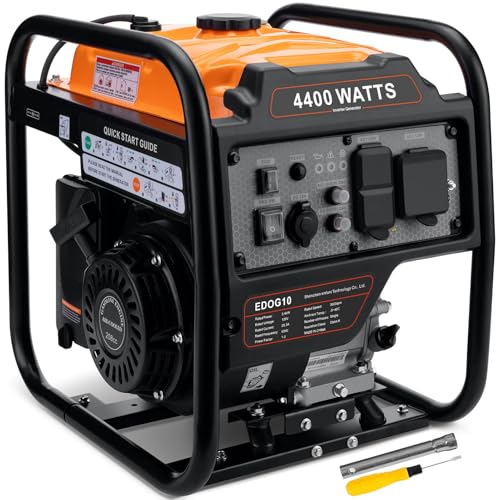
This open-frame inverter generator provides a practical balance of power and portability for home backup and RV use. It delivers 3400 running watts and 4400 peak watts, with a 2-gallon fuel tank offering up to about 14 hours of run time at 25% load. Features include multiple outlets (2x 120V, 1x 30A RV, 1x 12V DC), inverter technology, ECO mode, and low oil shutdown protection. The unit is designed for quick cold starts and smoother, cleaner energy suitable for sensitive electronics, making it a viable option for essential home circuits during outages.
Westinghouse 12500 Watt Dual Fuel

This dual-fuel powerhouse adapts to your fuel availability with both gasoline and propane options. It delivers up to 12500 peak watts (gasoline) and 9500 running watts, with an 8500 running watts and 11200 peak watts when powered by propane. A remote start with key fob adds convenience, and a 6.6-gallon fuel tank supports longer runtimes. The system includes a transfer switch-ready setup, multiple outlets including RV and 120V receptacles, and a digital hour meter for maintenance tracking, making it well-suited for larger homes and more demanding outages.
Westinghouse 14500 Peak Watt Tri-Fuel

Designed for large homes and demanding workloads, this tri-fuel unit runs on gasoline, propane, or natural gas. It offers up to 14,500 peak watts and 11,500 running watts on gasoline, and slightly lower figures for propane and natural gas. A robust 550cc engine powers the generator, which includes a sizable 9.5-gallon fuel tank with a built-in gauge. The unit is transfer-switch ready and provides substantial outlets including RV and 120/240V configurations, making it a strong option when full-home backup is required, regardless of fuel type.
DuroStar DS13000MX 13,000-Watt

The DS13000MX is a dual-fuel powerhouse designed for whole-home backup and RV use. It delivers 13,000 watts of power and supports both gasoline and propane, offering fuel flexibility during emergencies. A carbon monoxide (CO) alert adds a safety layer by automatically shutting the unit off if CO levels become dangerous. The transfer-switch-ready design makes it easier to connect to home electrical systems, while its rugged build is aimed at long-term reliability in storm-prone regions or off-grid scenarios.
PowerSmart 4400-Watt Inverter Generator

PowerSmart’s 4400-watt inverter offers a strong starting 4400W, with 3600W running capacity and an efficient 1.6-gallon fuel tank. It emphasizes quiet operation, with a typical sound output around 76 dB at 23 feet, making it suitable for neighborhoods and late-night outages. The unit includes dual outlets and ECO mode for fuel efficiency. Its compact profile makes it a candidate for portable backup for essential circuits and electronics while keeping noise and emissions in check.
Oxseryn 4400 Watts Inverter Generator

Another Oxseryn option mirrors the core specs: 4400 peak watts and 3400 running watts, designed for RVs and home backup. It offers two 120V outlets, one 12V DC port, and an RV port. A 2-gallon tank with a gauge and a 14-hour runtime at 25% load makes it a practical portable option for smaller homes or outdoor use where a quiet, reliable energy source is required. Eco mode and low-oil shutdown enhance safety and efficiency during extended outages.
Buying Guide: Key Purchase Considerations
- Power needs: Calculate essential circuits and total wattage. For most homes, a 5,000–7,500 watt unit covers fundamentals, while larger homes may require 10,000+ watts or a tri-fuel option.
- Fuel type and availability: Gas generators are common, but dual- or tri-fuel units add flexibility if one fuel becomes scarce. Propane and natural gas can offer longer shelf life and easier storage.
- Start method: Electric start is convenient, but ensure you have a reliable battery and backup pull-start as a fail-safe in winter conditions.
- Transfer switch compatibility: A transfer switch simplifies connections to household circuits and improves safety. Verify your panel compatibility and the number of circuits you plan to power.
- Noise and emissions: Inverter generators are generally quieter and better for sensitive electronics. CO sensors and automatic shutoffs add safety for indoor or semi-enclosed use.
- Portability vs. household-scale: Inverter units favor portability and efficiency; larger multi-fuel units focus on entire-home reliability, typically requiring more space and ventilation.
- Maintenance and warranty: Look for models with accessible service, clear maintenance intervals, and solid warranty support from reputable brands.
- Safety features: Low-oil shutdown, overload protection, CO sensors, and automatic shutoffs are important for protecting your home and family during outages.
When selecting a generator, align the unit’s capabilities with your specific outage scenarios, climate considerations, and the number of essential appliances you need to keep running. A well-chosen generator can provide peace of mind by ensuring core systems—refrigeration, heating, lighting, and communication—remain functional during extended power interruptions.