Discover top solar kit options to power an RV on the road or at a remote campsite. This guide compares popular 12V and 24V RV solar kits, highlighting efficiency, durability, and ease of setup. Each product is designed to deliver reliable daily output under typical sunlight, with components built for outdoor use and long life.
| Product | Key Benefit | Output Profile |
|---|---|---|
| ECO-WORTHY 200W 12V/24V Kit | High efficiency monocrystalline panels | 800 Wh/day under strong sun |
| Renogy Adventurer 200W Kit | Compact, versatile for RVs and boats | ~800 Wh/day with 30A PWM |
| Renogy 400W Premium Kit | High power with MPPT features | 2–2.5 kWh/day (varies with sun) |
| ECO-WORTHY 800W Complete System | All-in-one off-grid RV solution | ~3.2 kWh/day with 4x200W panels |
| ECO-WORTHY 200W Starter Kit | Beginner-friendly solar setup | 800 Wh/day, includes battery and inverter |
ECO-WORTHY 200W 12V/24V Solar Kit

The ECO-WORTHY 200W kit uses high-efficiency monocrystalline cells to deliver reliable daily output in RV use. The package includes a 30A PWM charge controller and components designed for RV, camper, and off-grid applications. The sturdy aluminum frame resists corrosion, while the IP65-rated junction box protects connections. In typical sun, expect around 800 Wh per day, depending on conditions. The system supports both 12V and 24V configurations for flexible RV setups.
Renogy 200W Adventurer Kit
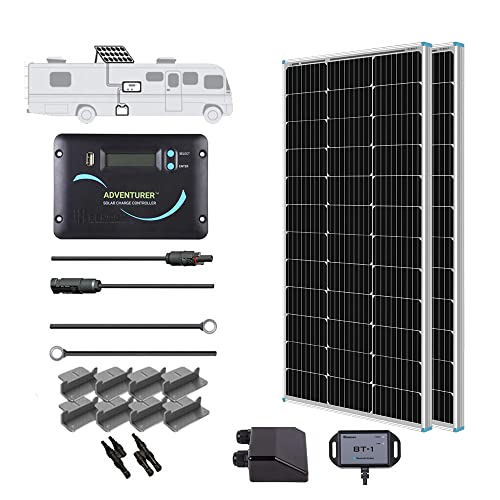
This kit pairs two 100W monocrystalline panels with a 30A Adventurer PWM controller. It is designed for RVs, boats, and trailers, providing a compact footprint with good efficiency. The corrosion-resistant frame ensures long outdoor life, with support for high wind and snow loads. The Adventurer controller includes protection against overcharging and short circuits, with simple flush mounting on walls to maintain a neat exterior appearance.
Renogy 400W Premium Kit

The Premium Kit includes four 100W panels, a 40A MPPT controller, and mounting hardware. With 22.5% panel efficiency and a robust frame, it handles wind and snow loads well. The MPPT controller uses 99% tracking efficiency and 98% peak conversion efficiency, delivering superior performance over PWM systems. The kit aims for higher daily energy yield and easier installation through pre-drilled holes and ready-to-use wiring.
ECO-WORTHY 800W Off-Grid System

This all-in-one system uses four 200W panels for a total of 800W, paired with a 3000W inverter/charger and a 60A MPPT controller. It supports a wide variety of RV appliances, including air conditioners and microwaves, by delivering up to 3.2 kWh daily under good sun. The kit emphasizes a quick, novice-friendly 4-step installation and long-term service with professional support. It’s designed to be fully compatible with mains charging as a UPS-like backup.
ECO-WORTHY 200W Starter Kit

This starter package aims at ease of use for RV travelers: two 100W panels, a 100Ah lithium battery, a 1100W inverter, and a 30A PWM controller. It provides about 800Wh of daily power with storage capacity of roughly 1.28 kWh. The kit includes step-by-step setup guidance and essential cables, making it a suitable entry point for off-grid RV enthusiasts seeking an all-in-one solution.
Buying Guide: Key Purchase Considerations And Comparisons
Power needs and configuration: Determine your RV’s daily energy use and whether you need 12V, 24V, or a hybrid system. Higher-wattage kits offer more headroom for appliances but require larger storage and mounting space.
Panel technology and efficiency: Monocrystalline panels typically provide higher efficiency and better performance in partial shade. Higher efficiency means more output per square foot, an advantage for limited roof space on smaller RVs.
Charge controller type: PWM controllers are affordable and adequate for simple systems, but MPPT controllers extract more energy, especially under variable conditions. If you plan to expand, consider MPPT from the start.
Durability and weather resistance: Look for corrosion-resistant frames, IP-rated junction boxes, and robust mounting hardware to withstand wind, rain, and road exposure.
Ease of installation: Starter kits with pre-wired components and detailed manuals reduce DIY time and error. A complete kit with inverter, battery, and cables simplifies setup for first-time installers.
Battery type and storage: Lithium batteries offer better depth of discharge and longer life than lead-acid, but require proper battery management. Assess your storage needs and climate expectations.
Warranties and support: Longer warranties on panels and controllers reduce long-term risk. Check included technical support and access to replacement parts if needed.
Expandability and future-proofing: If you anticipate adding more panels or larger storage later, choose a modular kit with compatible connectors and mounting options.
Overall, select a kit that aligns with your RV size, travel style, and typical sun exposure. Compare the daily output estimates in the catalog with real-world conditions you expect on the road. Pay attention to mounting practicality, cable routing, and compatibility with your existing electrical system for a smooth upgrade path.