Selecting the right sharpener for Japanese knives matters for home cooks and professionals alike. The best options blend traditional Japanese sharpening craft with modern convenience, offering durable stones, precise angle guidance, and safe, stable bases. This guide highlights five highly relevant sharpeners and whetstone sets designed to keep blades like Gyutos, Santokus, and Yanagibas razor-sharp. From compact multi-stone kits to precise adjustable sharpeners, these tools cover a range of grits and setups to suit every kitchen need.
| Product | Type | Grit Range | Notable Feature |
|---|---|---|---|
| Goodjob Knife Sharpening Stone Kit | Whetstone Kit | 400/1000 | Includes angle guide, flattening stone, and non-slip base; Japanese quality |
| Kai Seki Magoroku Diamond And Ceramic Sharpener | Diamond/Ceramic Sharpener | Diamond/Ceramic wheels | Three-stone system with angle-free sharpening |
| MITSUMOTO SAKARI Adjustable 5-Angle Sharpener | 3-Stage Sharpener | Coarse/Medium/Polish stages | Angle-lock technology for precise, repeatable sharpening |
| MITSUMOTO SAKARI Japanese Knife Sharpening Stone | Whetstone | 1000/3000 | Double-sided stone with non-slip wooden base |
| Intelitopia Complete Knife Sharpening Stone Set | Whetstone Kit | 400/1000 and 3000/8000 | Leather strop, flattening stone, and multi-base system |
Goodjob Japanese Whetstone Kit

The Goodjob kit provides a dual-grit 400/1000 whetstone set that meets everyday kitchen needs. It includes a fixed-angle guide to help beginners maintain a consistent sharpening angle, plus a white flattening stone to keep the surface true. The whetstones are designed for water-only use, simplifying cleanup and ensuring food safety. The package also includes a non-slip rubber base to stabilize the stone during sharpening, reducing the chance of slips and slips that can mar a blade edge.
Originating in Osaka, Japan, the Goodjob stones reflect traditional craftsmanship. The stones are fired at high temperatures to enhance hardness and durability, helping maintain a sharp edge over time. The kit is suitable for various kitchen knives and tools, delivering a reliable balance of speed and control for home cooks seeking a straightforward sharpening workflow.
- Affordable bundle with 400/1000 grit for sharpening and initial honing
- Angle guide supports fixed sharpening angles for consistent results
- Non-slip base and flattening stone aid accuracy and surface maintenance
- Water-only operation keeps maintenance simple
Kai Seki Magoroku Diamond And Ceramic Sharpener

Kai Seki Magoroku’s Diamond and Ceramic Sharpener uses three sharpening media: two diamond options and a ceramic stage. The system is designed for quick rejuvenation without manual angle setting, making it ideal for busy kitchens. Its compact footprint (about 5.6 x 2.0 x 2.2 inches) lets it store in a sink drawer or under the counter, preserving counter space while delivering dependable results for Japanese knives and other stainless cutlery.
The unit emphasizes ease of use: no need to adjust angles, and a compact form factor that fits small kitchens. The diamond stages aggressively reshape dull edges while the ceramic stage provides finishing polish to restore keen bite, making it suitable for everyday maintenance and small repairs on a range of blades.
- Three-stage sharpening system with diamonds and ceramic
- Compact, space-saving design
- Fixed-angle approach simplifies use for beginners
MITSUMOTO SAKARI Adjustable 5-Angle Sharpener

This sharpener combines a Japanese approach with modern mechanical precision. It features a precision guide rail and a 5-angle adjustable design, coupled with 3-wheel stages—diamond for coarse sharpening, ceramic for fine tuning, and steel for polishing. The result is a versatile tool that can restore edge geometry and finish across various knife styles. The anti-slip handle adds stability, reducing fatigue during longer sharpening sessions and helping users maintain control for consistent results.
Sharpeners in this line are popular for professionals and home cooks who want targeted control over edge geometry. The angle-lock technology helps maintain the chosen angle, minimizing mistakes and producing reliable knife edges with repeated use. This model supports accurate repairs and everyday maintenance without extensive technique knowledge.
- 5-angle adjustment with dedicated coarse, fine, and polish stages
- Angle-lock mechanism for repeatable results
- Anti-slip handle for safer use
MITSUMOTO SAKARI Japanese Knife Sharpening Stone
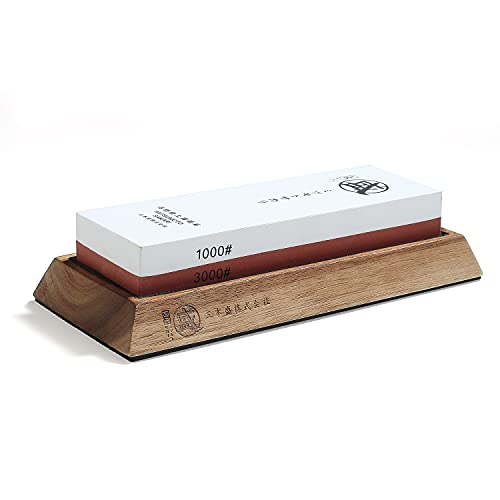
This professional-grade sharpening stone from Mitsumoto Sakari features a double-sided 1000/3000 grit configuration on a non-slip wooden base. Soaking in water activates the corundum-based stone for efficient grinding and smoothing. The 15°–20° recommended sharpening angle helps home cooks and professionals maintain proper edge geometry for chef’s knives, santoku, and other common kitchen blades. The wooden base stabilizes the stone, reducing movement during use and promoting safe sharpening.
Designed for long-term use, this stone addresses routine blade maintenance—from rough dulling to refined finishing. The 1000 grit side quickly restores an edge, while the 3000 grit provides a smoother polish suitable for everyday kitchen knives and some higher-end blades. Proper soaking and flatness maintenance are key for consistent performance over time.
- Double-sided 1000/3000 grit for grinding and polishing
- Non-slip wooden base with protective rubber on the bottom
- Simple water-based operation for easy maintenance
Intelitopia Complete Knife Sharpening Stone Set

The Intelitopia kit presents a comprehensive sharpening system with dual-ended whetstones covering 400/1000 and 3000/8000 grits. It also includes a coarse flattening stone, a leather strop, a non-slip bamboo base, and an angle guide. This makes it suitable for restoring dull blades and delivering a razor finish on a variety of kitchen knives, including Japanese brands. The leather strop helps remove burrs after sharpening and adds a final polish to edges.
Designed as a multi-tool for both beginners and seasoned users, the kit guides you through a complete sharpening workflow. The included instruction manual breaks down the steps and helps users understand how to select the appropriate grit for different blade conditions, ensuring consistent, professional results at home.
- Complete set with 400/1000 and 3000/8000 grit whetstones
- Leather strop and flattening stone for edge finishing
- Non-slip bamboo base and angle guide for stability
Buying Guide
Grits and stone types
Shapening Japanese knives typically relies on a progression from aggressive grits (around 400–1000) to fine finishes (2000–8000). Whetstones built from aluminum oxide or corundum provide consistent edges when used with water. Double-sided stones save space and cost, while higher grit levels produce smoother, longer-lasting edges. Consider whether you prefer a bundled kit with multiple grits or a single specialty stone for specific maintenance tasks.
Set versus standalone tools
All-in-one kits, like Intelitopia’s set, offer a complete sharpening workflow—from rough repair to final polish—plus accessories like a leather strop and flattening stone. Standalone stones or compact two-way systems focus on a narrow function, often with dedicated angle guides. Your choice depends on your knife collection, storage space, and how much you value portability versus a comprehensive system.
Angle guidance and adjustability
Fixed-angle guides help beginners establish a consistent edge, while adjustable or multi-angle sharpeners (such as the Mitsumoto Sakari 5-Angle) support a broader range of blades and bevels. For traditional Japanese knives with 15–20 degree bevels, angle guides that encourage precise, repeatable angles are especially beneficial. Consider your comfort level and willingness to learn a sharpening routine when choosing between fixed and adjustable systems.
Base stability and safety
A stable, non-slip base reduces the risk of accidents and blade damage. Bamboo bases and rubberized bottoms are common features that keep stones in place during use. A secure setup is particularly important for larger or heavy knives and for users who sharpen with one hand while holding the blade with the other.
Maintenance and care
Proper cleaning and flattening are essential to maintain stone flatness and ensure even edge contact. Wet stones require soaking (per stone instructions) and periodic flattening to prevent high spots. A flattening stone, included in several kits, helps extend the life of your whetstones by preserving a true sharpening surface. Keep stones dry between uses to minimize bacterial growth and prolong material integrity.
Blade compatibility and edge goals
Most Japanese knives respond well to grits in the 1000–3000 range for routine maintenance and edge polish. For heavy-duty work or damaged blades, an initial 400–600 grit can expedite edge repair. Finish grits around 6000–8000 yield a mirror-like polish but can be more demanding to maintain. Tailor your grit selection to blade type, steel hardness, and intended use in the kitchen.
Brand reputation and support
Brands with a long history in knife making—such as Kai and Mitsumoto Sakari—tend to offer reliable performance and clear maintenance guidance. Japanese-origin products often reflect traditional sharpening standards and focus on blade preservation. Check for warranty coverage and accessible customer support when comparing options.
In summary, the best sharpener for Japanese knives balances grit variety, stability, and ease of use. Kits that pair multiple grits with angle guidance and safety features provide the most versatility for an expanding knife collection, while targeted single-stone solutions suit users who prefer a compact, focused setup. Whichever option you choose, consistent use paired with correct technique yields the best long-term edge retention for authentic Japanese blades.