If you need reliable two-hole rubber stoppers for lab glassware, this guide highlights five solid options and explains who each is best for. These stoppers seal tubes, flasks, and vessels while allowing venting or insertion of accessories. They are suited for school labs, research settings, and industrial environments where chemical compatibility and a snug fit matter. The items below vary in size and material, so you can pick the best match for your containers and sealing needs.
Buyer’s quick reference table:
| Product | Top Ø | Bottom Ø | Height | Material | Best For |
|---|---|---|---|---|---|
| uxcell 6 Pcs 2-Hole (24x18x25mm) | 24 mm | 18 mm | 25 mm | Solid Rubber | Standard lab tubes and flasks |
| uxcell 6 Pcs 2-Hole (32x26x25mm) | 32 mm | 26 mm | 25 mm | Solid Rubber | Larger tubing and flasks |
| EISCO Neoprene Stoppers 2 Holes (Size #4) | 26 mm | 20 mm | 25 mm | Neoprene | Petroleum, oils, inorganic acids and bases compatible |
| uxcell 2 Pcs 2-Hole (27x23x25mm) | 27 mm | 23 mm | 25 mm | Solid Rubber | Medium-size vessels and test setups |
| uxcell 4 Pcs 2-Hole (27x23x25mm) | 27 mm | 23 mm | 25 mm | Solid Rubber | Bulk needs with medium-size fits |
uxcell 6 Pcs 2-Hole Rubber Stopper, 24x18x25mm

These stoppers are solid rubber with a tapered design. The top diameter is 24 mm and the bottom diameter is 18 mm, with a height of 25 mm. They are described as high-density, elastic, and durable, offering good sealing and insulation. Best for standard laboratory tubes and flasks where a reliable seal is needed across multiple vessels. Best for buyers who need bulk quantities of a medium-size stopper. Caution: verify the fit for non-standard containers to avoid leaks.
uxcell 6 Pcs 2-Hole Rubber Stopper, 32x26x25mm
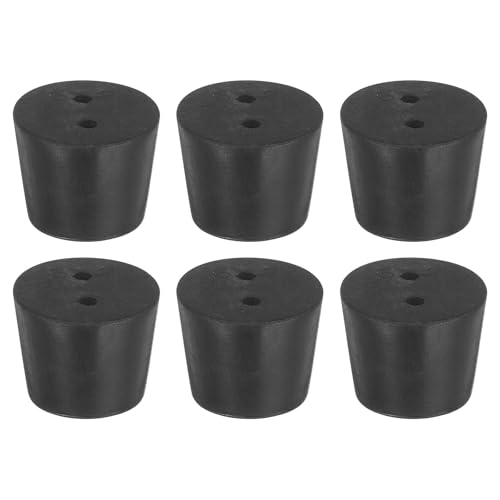
This set uses a larger top diameter of 32 mm with a bottom of 26 mm and 25 mm height. Made from solid rubber for high density and seal integrity, the design includes a tapered body for easier insertion and removal. Best for larger test tubes and flasks where a tighter seal is needed. Choose this if your vessels require a bigger opening. Limitation: may not fit smaller-neck containers without a proper seal.
EISCO 10PK Neoprene Stoppers, 2 Holes (Size #4)

These stoppers are neoprene and sized to ASTM recommendations, with a top diameter of 26 mm and bottom diameter of 20 mm, plus a 25 mm length. The pack contains multiple stoppers, suitable for petroleum, oils, and most inorganic acids and bases. Best for chemical setups where higher chemical resistance is desirable. Better for liquids that contact rubber-sensitive configurations. Caution: neoprene is not compatible with some strong solvents; verify chemical compatibility with your reagents.
uxcell 2 Pcs 2-Hole Rubber Stopper, 27x23x25mm

This pair offers a medium-top diameter of 27 mm and a bottom of 23 mm with 25 mm height. The stoppers are described as high-density, elastic, and durable, with a smooth tapered surface for easy insertion and removal. Best for mid-sized vessels and bench-top experiments requiring a modest seal. Limitation: smaller top opening may limit compatibility with some wide-neck containers.
uxcell 4 Pcs 2-Hole Rubber Stopper, 27x23x25mm

The four-pack matches the 27x23x25 mm size, with a 27 mm top and 23 mm bottom. It is described as solid rubber, high density, and highly durable, providing a reliable seal for lab and industrial use. Best for bulk buys where a consistent fit is needed across several vessels. Caution: check for chemical compatibility if using in aggressive solvent environments.
EISCO 10PK Neoprene Stoppers, 2 Holes – Size #2

These neoprene stoppers have two holes and follow ASTM standards for size #2, with a 25 mm length, 20 mm top, and 16 mm bottom. They are designed for compatibility with petroleum and most inorganic acids and bases. Best for lighter-duty lab tasks or smaller-scale setups. Better for users who require consistent small-hole stoppers. Limitation: may offer less sealing strength for larger-diameter vessels.
Herco Black Rubber Two-Hole Stopper (Size 4) — 4 pcs

Herco’s 2-hole stoppers are a multipurpose black rubber option with a top diameter of 26 mm and bottom 20 mm, standing 25 mm tall. This standard-size stopper is suitable for common lab, household, and industrial needs. Best for general purpose use when you want a dependable, widely compatible seal. Caution: ensure chemical compatibility with specific reagents used in your workflow.
GSC International RS-9-2 Rubber Stoppers, Size 9
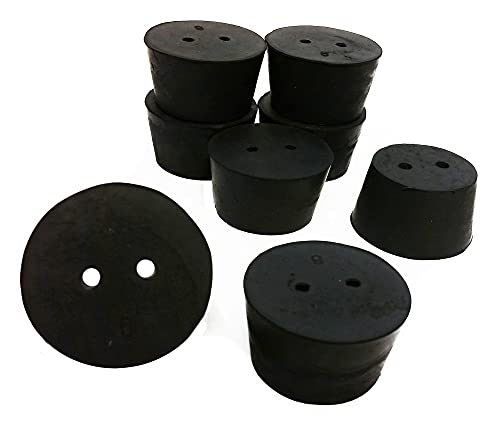
GSC International RS-9-2 offers size #9 two-hole rubber stoppers in a compact, black finish. This option targets users needing a smaller outer diameter with two holes to accommodate tubing or ventilation. Best for precise, small-scale lab setups. Caution: check container inner diameter to avoid fit issues with larger bottles.
Buying Guide
- Material: Rubber vs neoprene affects chemical compatibility and flexibility. Neoprene handles petroleum-based reagents, while natural or synthetic rubber suits general lab use but may have limited solvent resistance.
- Size fit: Top diameter controls compatibility with vessel openings. Bottom diameter and height affect seal depth and stability. Measure your containers before selecting.
- Number of holes and hole size: Two holes allow vents or insertion of thermometers or adapters; ensure hole diameter matches your needs (commonly 4–5 mm holes).
- Durability and density: Higher density rubbers resist wear and deformation longer, helpful in repeated use. Durable stoppers reduce replacement frequency.
- Chemical compatibility: If you work with oils, acids, bases, or solvents, verify material compatibility to prevent degradation or leakage.
- Bulk vs single: Bulk packs are cost-effective for teaching labs or large setups, while smaller sets suit specific projects.
FAQ
- What is the purpose of two holes in a stopper?
– Two holes allow venting or insertion of accessories while maintaining a seal around the vessel neck. - What material should I choose for solvent use?
– Neoprene stoppers perform well with many oils and bases, but verify compatibility with your exact solvent. - How do I determine the right stopper size?
– Match the stopper top diameter to the vessel opening and ensure the bottom diameter provides a snug seal. - Are these reusable?
– Most solid rubber and neoprene stoppers are designed for repeated use, but inspect for cracks or wear before reuse. - Can I mix two-hole stoppers with different container types?
– Yes, as long as the top and bottom diameters fit the specific vessel to prevent leaks.