For indoor growing, the quality of your water matters as much as your nutrients. Reverse osmosis (RO) systems deliver water with minimal dissolved solids, enabling precise nutrient control and stable pH for hydroponics and germination stages. This guide highlights five RO systems well-suited for growing operations, balancing filtration strength, remineralization, and installation practicality. Whether you’re running a small balcony setup or a home grow, these options help you tailor water quality to your plants’ needs while keeping maintenance manageable.
Use this quick reference to compare capabilities, from daily output to remineralization features and DI options. The following table summarizes the five chosen systems to support growing efforts, helping you pick a unit that aligns with your space, throughput, and water chemistry requirements.
| Product | Brand | GPD | Stages | Notes |
|---|---|---|---|---|
| iSpring RCC7AK | iSpring | 75 | 6 | Alkaline remineralization; top-mounted design |
| Express Water RO5DX | EXPRESS WATER | 50 | 5 | NSF-certified; easy under-sink install |
| APEC ROES-PH75X | APEC | 75 | 6 | Calcium remineralization; pH enhancement |
| Aquatic Life Hydroponic RO | Aquatic Life | 200 | 5 | High-capacity RO for hydroponics |
| Aquatic Life 4-Stage RO/DI | Aquatic Life | 100 | 4 | RO/DI with DI resin optimization |
iSpring RCC7AK 6-Stage RO System

The iSpring RCC7AK is a 6-stage RO system rated at 75 GPD, designed for reliable, high-purity water suitable for growing. A standout feature is the patent-pending top-mounted design that enables installation from above, simplifying countertop setups and reducing under-sink work. The AK remineralization stage introduces minerals to produce water with a balanced pH and essential minerals—beneficial when preparing nutrient solutions for hydroponics. Additionally, the transparent first-stage housing makes it easy to monitor sediment buildup, supporting timely filter changes and consistent water quality for plants.
From a growing perspective, remineralized water helps maintain stable pH and nutrient uptake in many hydroponic systems. The top-mount faucet and streamlined tubing simplify routine maintenance, which is helpful for growers juggling multiple tasks. While it delivers clean, mineral-balanced water, regular cartridge replacement and membrane care remain essential to sustain performance in a busy growing environment.
Express Water RO5DX 5-Stage RO System

The Express Water RO5DX is a 5-stage reverse osmosis filtration setup designed for under-sink installation, delivering up to 50 GPD. It reduces up to 99.99% of common contaminants—lead, chlorine, fluoride, PFAs/PFOs, arsenic, and more—providing water suitable for precise hydroponic nutrient mixing and irrigation. The package typically includes a dedicated faucet and storage tank, aiding a straightforward DIY setup. Its design emphasizes clear cartridge labeling and accessibility, helping growers maintain consistent water quality without specialized tools.
In hydroponic applications, this system provides a reliable baseline of contaminant-free water, which helps stabilize nutrient solutions. Regular cartridge replacements and routine membrane checks are crucial to maintain performance. For small to mid-sized grow spaces, the 50 GPD capacity aligns well with moderate water usage, though larger operations may benefit from higher-output models to shorten bottlenecks during peak demands.
APEC ROES-PH75X 75 GPD RO System

APEC’s ROES-PH75X is a 6-stage RO system rated at 75 GPD with a calcium-based remineralization stage to boost alkalinity and improve taste. It promises up to 99% removal of impurities including chlorine, taste and odor, VOCs, fluoride, arsenic, lead, and other contaminants, with a maximum allowed total dissolved solids (TDS) of 2000 ppm. The system uses premium components and a reinforced design for durability. A feed water pressure range of 40–85 psi ensures compatibility with most residential supplies, while the remineralization stage provides minerals that can support stable hydroponic water chemistry.
For growers, the combination of strong filtration and mineral boost helps maintain consistent nutrient solutions and soil- or media-based pH levels when needed. Regular filter changes and pre-filter maintenance help preserve membrane efficiency and extend system life, which is beneficial in a growing setup where water quality directly influences plant performance.
Aquatic Life Hydroponic RO 5-Stage 200 GPD

This high-capacity hydroponic RO system delivers up to 200 GPD, designed to meet the water demands of growing operations. Its five-stage filtration train removes chlorine, chloramines, heavy metals, and total dissolved solids, producing water that supports precise nutrient formulation and stable pH for hydroponic crops. The package includes essential components and tools, such as membrane cartridges and pre-filters, to simplify setup and ongoing maintenance. For growers, the capability to generate large volumes of purified water ensures consistency across cycles and helps scale operations without frequent downtime for filtration changes.
In practice, this unit’s high throughput makes it well-suited for larger home grows or small commercial setups that require steady water supply for multiple reservoirs. As with all RO systems, keep an eye on membrane life and DI needs if you pursue ultra-low TDS water for sensitive crops. Regular checks on water quality and nutrient compatibility will maximize growth outcomes.
Aquatic Life 4-Stage RO/DI 100 GPD
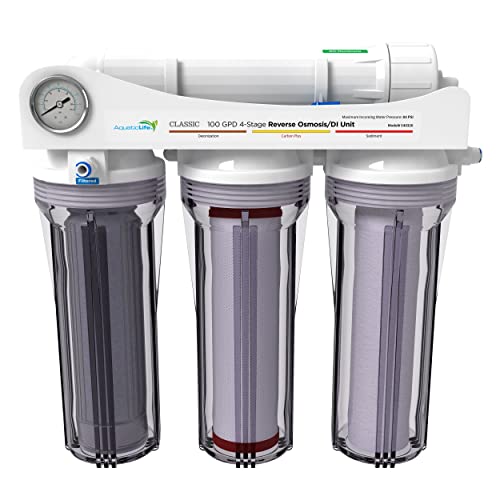
The Aquatic Life 4-Stage RO/DI system provides up to 100 GPD of purified water with a four-stage filtration sequence that includes a sediment filter, a Carbon Plus cartridge, a 100 GPD RO membrane, and a DI resin cartridge. The RO membrane reduces Total Dissolved Solids (TDS) to near-zero levels when DI resin is used, delivering extremely pure water. This setup is popular for aquarium care and hydroponic use where precise water chemistry matters. The included DI stage is particularly valuable for growers who want to push water quality toward ultra-pure levels while maintaining manageable maintenance routines.
For hydroponics, this system provides a reliable path to consistent, low-EC water for nutrient formulation. Regular DI resin changes and periodic membrane checks help sustain performance. The compact footprint and straightforward maintenance make it a practical choice for grow spaces with limited installation room, while still delivering the water quality needed for high-precision nutrient management.
Buying Guide
Key considerations for selecting a hydroponics-ready RO system
- Water source and quality: Municipal water vs. well water affects initial TDS and dissolved solids. Systems with a robust membrane and optional DI stage handle higher TDS more effectively.
- Daily output (GPD): Hydroponic setups vary in demand. Choose 50–75 GPD for small grows, 100–200 GPD for larger or multi-reservoir systems, and higher if you run continuous cycles or multiple zones.
- Filtration stages and remineralization: For growing, consider at least 5–6 stages with an option to remineralize or add minerals to support plant health and stable pH.
- Remineralization and pH management: pH-stabilizing stages (like calcium-based remineralization) help maintain nutrient availability and reduce pH drift in hydroponics.
- DI compatibility: For ultra-low TDS water, a DI resin stage can produce near-zero TDS, beneficial for sensitive crops or high-precision nutrient regimes.
- Installation and maintenance: DIY-friendly setups with standard fittings save time. Look for clear instructions, readily available replacement cartridges, and accessible service life indicators.
- Wastewater considerations: RO systems produce wastewater. Check the rejection ratio and plan for disposal or reuse to optimize water use in growing operations.
- Certifications and build quality: NSF/ANSI certification and durable housings indicate reliability and safer materials in contact with water used for plants.
- Size and footprint: Under-sink units save space, while larger hydroponics rigs may benefit from compact, high-capacity units designed for easy parallel installation.
How to compare options for growing applications
- Filtration strength vs. remineralization: Units with mineral stages or calcium supplementation provide a more plant-friendly form of drinking-quality water suitable for nutrient solutions.
- Throughput vs. growth scale: For multi-reservoir systems, opt for higher GPD to avoid bottlenecks during peak use. For compact grows, lower GPD with DI options may suffice.
- Maintenance cadence: Evaluate filter replacement intervals and the availability of service parts. Systems with transparent housings or clear indicators help schedule timely changes.
- System versatility: DI-ready or pre-wired configurations allow easier upgrades as your grow expands or diversifies into different crops.
- Cost of ownership: Consider cartridge and membrane costs, plus potential water waste. A slightly higher upfront investment may reduce long-term maintenance hassles.
Selecting the right RO system for growing involves balancing water quality needs, space, and maintenance. For hobbyist grows, a compact 50–75 GPD unit with remineralization often suffices, while larger or commercial setups benefit from higher-capacity RO systems with DI options. Regardless of the choice, regular monitoring of water chemistry and nutrient uptake remains essential to achieving consistent, healthy plant growth.