Hydroponics thrives on clean, balanced water. Reverse osmosis (RO) systems remove a wide range of dissolved minerals and contaminants, giving you a consistent baseline for nutrient solutions. The following five RO systems are among the best options for hydroponic setups, offering different levels of filtration, flow, and remineralization features. Each product below is chosen for reliability, ease of installation, and compatibility with typical home hydroponic reservoirs.
| Product | Filtration | Max GPD / Notes |
|---|---|---|
| Aquatic Life RO Buddie 3-Stage System | 3-stage RO | 75 GPD |
| Aquatic Life 5-Stage Hydroponic RO System | 5-stage RO | 200 GPD |
| iSpring RCC7AK 6-Stage RO System | 6-stage RO with pH+ remineralization | 75 GPD |
| Max Water 6-Stage RO-DI System | RO + DI | 100 GPD |
| Home Master HydroGardener TMA-HG-Pro | RO with remineralization | High efficiency, well-suited for hydro setups |
Aquatic Life RO Buddie 3-Stage System

The Aquatic Life RO Buddie is a compact 3-stage reverse osmosis system designed specifically for hydroponics. It delivers up to 75 gallons per day, providing a reliable supply of filtered water for nutrient solutions and reservoir top-offs. The system focuses on removing a high percentage of total dissolved solids, helping to stabilize nutrient uptake and reduce variability in hydroponic mixes. The RO membrane filtration reduces TDS to a level that supports precise control over nutrient balance, which is essential for consistent plant growth in hydroponic systems.
Key features include a 3-stage filtration train, a capacity suitable for small to mid-size hydroponic setups, and a focus on removing up to 98% of TDS. This makes it a practical option for growers who want simplicity, lower water waste, and straightforward maintenance. The compact footprint also helps in grow rooms with limited space. For hobbyists and compact commercial gardens, the Buddie provides dependable performance without a heavy installation footprint.
Maintenance is straightforward, with standard replaceable membranes and pre-filter cartridges. Replacement intervals depend on water quality and usage, but routine checks of membrane integrity and sediment/carbon pre-filters will help maintain output quality. This unit is best suited for growers who need a reliable 75 GPD supply and are comfortable managing a 3-stage system in a hydroponic setup.
Overall, the Aquatic Life RO Buddie offers an affordable, compact RO option that aligns well with hobbyist to small commercial hydroponics. It’s ideal for growers who prioritize consistent water quality and a simple, dependable filtration train without the complexity of higher-capacity systems.
Aquatic Life 5-Stage Hydroponic RO System

The Aquatic Life 5-Stage Hydroponic RO System is a higher-capacity option designed to support robust hydroponic operations. With up to 200 GPD, this system provides more filtered water to sustain larger reservoirs or multiple grow beds. The five-stage design tackles a broad spectrum of contaminants, including chlorine, chloramines, heavy metals, and various dissolved solids, resulting in water that is well-suited for nutrient stability and consistent EC/ppm management in hydroponic nutrient solutions.
The package includes a variety of accessories, such as canister wrenches and multiple cartridges, which eases installation and ongoing maintenance. The system’s design focuses on easy maintenance and quick cartridge changes, helping growers minimize downtime during feeding cycles. For those running multiple hydroponic channels or larger setups, the 200 GPD capacity can significantly reduce refill intervals and support larger nutrient regimes.
In practice, higher GPD capacity means your reservoir can stay topped up with less handling, which is helpful for maintaining stable nutrient delivery and reducing fluctuations caused by water changes. The multiple-stage filtration also helps reduce total dissolved solids and unwanted compounds that can affect plant health and flavor profiles in hydroponic crops.
Overall, this system is a strong choice for serious hobbyists or small commercial hydroponic growers who require higher water throughput, stronger filtration, and a broad set of included accessories to simplify installation and upkeep.
iSpring RCC7AK 6-Stage RO System

The iSpring RCC7AK offers a six-stage RO filtration train and introduces a remineralization stage (AK) to restore healthy minerals to the filtered water. This is particularly useful for hydroponics, where maintaining a baseline mineral presence can support nutrient uptake while still providing the refined water needed to control EC levels precisely. A top-mounted design simplifies installation, particularly for countertop or above-sink configurations, which can be beneficial in tight grow rooms or spaces with limited under-sink access.
Notable features include the patent-pending top-mounted fastener for easier setup, a transparent first-stage housing to monitor contaminant buildup, and a remineralization stage that adds essential minerals to the water. These aspects help growers achieve a stable pH and mineral balance in hydroponic systems, which can contribute to stronger growth and more predictable yields. The system’s 75 GPD output makes it suitable for mid-sized grow operations where space and simplicity matter.
Maintenance revolves around filter and membrane changes driven by water quality. The transparent housing assists with timely replacements, while the remineralization stage requires monitoring to avoid over-mineralization. For hydroponics that benefit from stabilized mineral content without sacrificing filtration depth, the RCC7AK provides a balanced approach with added mineral management.
Max Water 6-Stage RO-DI System
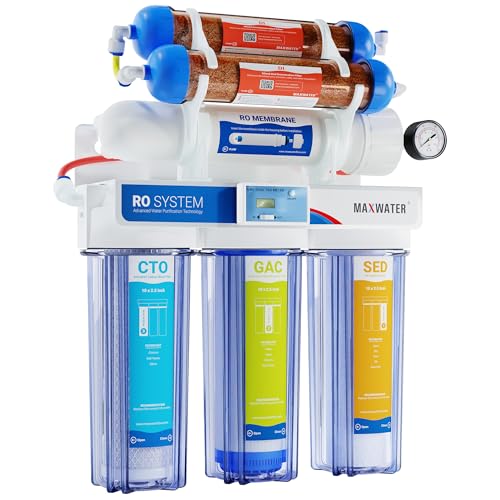
The Max Water 6-Stage RO-DI System combines RO filtration with a deionization (DI) stage to achieve very low TDS water, which is beneficial for hydroponic precision. With up to 100 GPD, this system can support moderate to larger hydroponic setups where a consistent supply of purified water is essential for maintaining stable nutrient solutions and overall plant health. The DI stage helps push TDS down to very low levels, yielding water that minimizes ionic interference in nutrient formulations.
Key strengths include robust impurity reduction, the inclusion of DI filtration after RO, and color-coded quick-connect fittings that simplify installation and service. The combination of RO and DI filtration is particularly appealing for growers who demand ultra-pure water for high-ppm nutrient regimes or sensitive crops where even minor mineral fluctuations can impact growth. System maintenance typically focuses on DI resin changes and RO membrane life, with water quality testing guiding replacement schedules.
In practical hydroponic terms, this system provides a reliable path to ultra-clean water, reducing the risk of contaminant buildup and offering predictability in EC management. It suits growers who prioritize raw water quality and are prepared to manage a slightly more involved filter change routine to maintain peak performance.
Home Master HydroGardener TMA-HG-Pro

The Home Master HydroGardener is a feature-rich RO system designed with hydroponics in mind. It delivers excellent contaminant removal and is engineered to perform well even at lower pressures, a common condition in well-water setups. The system emphasizes enhanced mineral delivery, incorporating calcium and magnesium into the output water to improve taste and overall water quality while still providing high-purity RO water for hydroponic applications.
With an emphasis on reliability, the HydroGardener is designed to operate efficiently at pressures as low as 35 psi, which makes it accessible for many well-water scenarios. The built-in remineralization helps address the common concern of water that is too soft for certain nutrient regimes, ensuring growers have a more balanced starting point for nutrient solutions. This makes it a practical choice for gardeners who need robust filtration and a more complete mineral profile in the filtered water.
Maintenance involves standard filter and membrane changes, as well as periodic checks of mineral delivery performance. For hydroponics that require stable water quality, reliable contaminant removal, and a thoughtful remineralization layer, the HydroGardener provides a balanced, dependable option that aligns with varied water sources and grow room demands.
Buying Guide
Choosing the right RO system for hydroponics involves evaluating water quality, system capacity, and how you plan to manage nutrient solutions. Here are essential considerations to guide your decision:
- Water source and quality: Municipal tap water often contains chlorine and chloramines; well water may bring iron, manganese, or high total dissolved solids (TDS). Consider pre-filtration and whether a RO-DI combination is necessary for your setup.
- Filtration stages and minerals: A higher stage count (five or six stages) generally provides stronger filtration and more options for remineralization. If your hydroponic strategy relies on precise EC/ppm control, remineralization options can be valuable to restore essential minerals after filtration.
- GPD capacity and reservoir size: For small to medium gardens, 75–200 GPD covers most daily needs. Larger commercial setups may require higher throughput or staged distribution. Consider whether you will run a single reservoir or multiple systems in parallel.
- DI post-treatment: RO systems with a DI stage achieve very low TDS, which can be advantageous for sensitive crops or precise nutrient formulations. However, DI adds ongoing resin replacement costs and requires monitoring the resin state to avoid performance loss.
- Installation and space: Under-sink versus countertop mounts affect space planning. Some units offer top-mounted faucets for easier installation in tight spaces, while others rely on standard under-sink configurations.
- Maintenance and operating costs: Filter and membrane replacement frequency depends on input water quality and usage. Membranes last longer in lower-TDS water, while sediment and carbon pre-filters may require more frequent changes.
- Certifications and reliability: Look for WQA Gold Seal or NSF/ANSI certifications when possible, as they provide assurance of claims and material safety. Brand reputation and customer support are also important for hydroponics users who depend on consistent water quality.
- System compatibility with hydroponic setups: Ensure your chosen system can be integrated with your reservoir, dosing pumps, and nutrient mix. Some units offer easy-to-read flow indicators and straightforward cartridge replacements that reduce downtime during feed cycles.
- Cost vs. value: Higher-capacity systems or those with remineralization and DI stages can be more expensive upfront, but they may reduce maintenance complexity and improve growth consistency over time.
In summary, for hydroponics, choose a system that aligns with your reservoir size, water source, and the mineral balance you target. If you operate a smaller setup with modest water needs, a 3-stage or 5-stage system with optional remineralization can be ideal. For larger grows or water supplies with high impurities, RO-DI combinations or remineralizing stages provide the consistency required for precise nutrient management. Regardless of choice, regular monitoring of water quality and reservoir parameters is key to achieving stable, healthy plant growth.