Answering the question of which residential sewer lift pump fits a home’s drainage needs, this guide highlights five reliable options. These submersible pumps handle septic or sump basins, basements, and below-grade installations with automatic or manual operation. They’re best for homeowners seeking dependable water removal, clog resistance, and straightforward setups. The top picks span a range of horsepower and flow rates, helping you compare capacity, lift height, and solids handling to match your basement or crawlspace conditions. The table below provides quick reference to each product’s core specs.
| Product | Best For | Key Specs |
|---|---|---|
| Acquaer Sewage Pump, Cast Iron, 2” NPT | Basements with solid debris | 3/4 HP, up to 6400 GPH, 29 ft lift, 2″ solids |
| FOTING 1.5HP 9000GPH | Heavy-duty basements and septic ties | 1.5 HP, up to 9000 GPH, 29 ft lift, 2″ discharge |
| FOTING 1HP 6000 GPH | General residential drains below grade | 1 HP, up to 6000 GPH, 32 ft lift, 1-1/2″ discharge |
| FLUENTPOWER 5000GPH | Medium-capacity basements | 3/4 HP, up to 5000 GPH, 21 ft lift, 2″ discharge |
| VEVOR 1HP 5200 GPH | Residential basements with modest flow | 1 HP, up to 5200 GPH, 25 ft lift, 2″ discharge |
Acquaer Sewage Pump, Cast Iron, 2” NPT Discharge
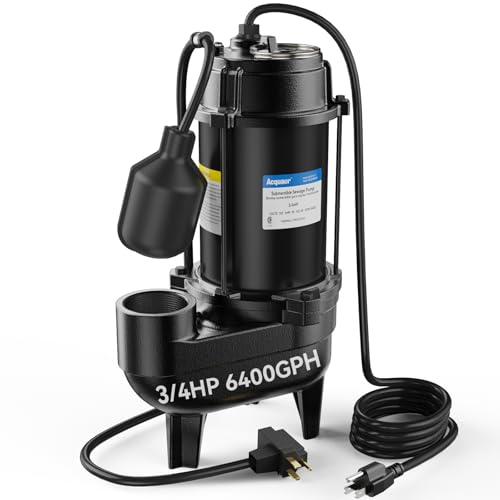
Best for: Homeowners needing strong solids handling in basements with limited space. This 3/4 HP submersible pump features an oil-filled motor for efficiency and a cast-iron body for durability. It can move up to 6400 GPH and lift to 29 feet, with a 2″ discharge able to pass 2″ solids. The auto/manual float switch enables hands-free operation, while the 10-foot cord supports flexible placement. Caution: Do not lift by the power cord to prevent damage.
FOTING 1.5HP 9000GPH Sump Pump

Best for: Large basements or septic pump setups requiring high flow. With a 1.5 HP PSC motor, this pump reaches up to 9000 GPH and lifts to 29 feet. It uses a rugged cast iron casing and a non-clogging vortex impeller, and includes a tethered float switch for automatic operation. The 10-foot cord and piggyback plug simplify installation. Caution: Avoid lifting by the power cord.
FOTING 1HP 6000 GPH Submersible
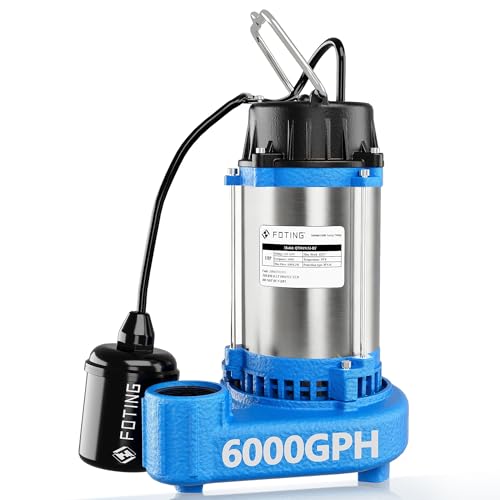
Best for: Homes needing solid performance with a moderate lift. This pump delivers up to 6000 GPH and lifts 32 feet, with a cast iron body and stainless components for durability. It uses a 2″ NPT discharge and a tethered float switch for auto operation. The buildup protection helps prevent jams. Caution: Never lift by the power cord to avoid damage.
FLUENTPOWER 5000GPH Sewage Pump

Best for: Mid-range basement drainage with automatic control. The 3/4 HP motor powers up to 5000 GPH with a 2″ discharge and a maximum lift of 21 feet. A full cast iron housing and anti-clogging vortex impeller provide durability, while the automatic vertical float switch supports hands-free operation. Caution: The manual operation option requires plugging and unplugging in pleased conditions; ensure a safe outlet setup.
VEVOR Submersible Sewage Pump, 1 HP, 5200 GPH
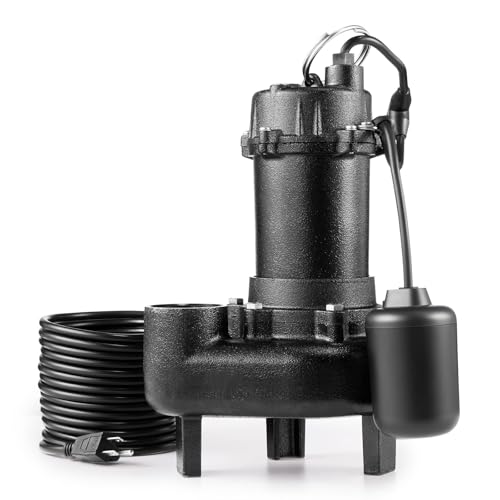
Best for: Homeowners needing reliable submersion with solid performance. This 1 HP pump delivers up to 5200 GPH and lifts water up to 25 feet. It uses a rust-resistant cast iron frame and an IPX8 rating for full submersion, with a tethered float switch for automatic operation. Caution: Submersion tolerances vary; ensure the basin dimensions fit the 2″ discharge configuration.
VEVOR Submersible Sewage Pump, 3/4 HP, 6000 GPH

Best for: Lower-cost, higher-flow option in smaller basements. This 3/4 HP pump can move up to 6000 GPH with a 2″ discharge and a 23 ft lift. It includes a tethered float switch for automatic control and a durable cast iron body. Caution: Check that the 2″ discharge aligns with your drainage piping.
Buying Guide
- Flow rate and lift height: Calculate needed GPH and vertical lift based on your sump depth and distance to outdoor drainage. Choose a model with a comfortable margin above your typical peak water load.
- Discharge size: Most residential pumps use a 2″ NPT discharge. Verify compatibility with piping and check if adapters are needed for your setup.
- Materials and durability: Cast iron housings and stainless components improve longevity in dirty water and basement environments. Consider oil-filled motors for heat management and quieter operation.
- Automatic vs. manual operation: Float switches enable automatic operation, which is safer and more convenient for unattended basements. Look for piggyback plugs if you want quick retrofits.
- Clog resistance: Pumps with reinforced vortex impellers and proper impeller design reduce debris clogs in solids-laden wastewater.
- Submersible suitability: Ensure the pump and wiring are rated for continuous submersion and follow safety guidelines for electrical outlets near water.
- Installation notes: Keep cords away from wet areas; do not pull or lift the unit by the power cord. Confirm basin size and clearance for maintenance access.
FAQ
- What size pump do I need for a small basement sump?
Answer: A pump around 3/4 HP to 1 HP with a 2″ discharge typically suits small to medium basements, offering adequate GPH without excessive power use. - Can I use a sewage pump for a home sump?
Answer: Yes, most residential sewage pumps are designed for sump basins and basement drainage, but review solids handling to ensure it matches debris size. - Is automatic operation necessary?
Answer: It reduces the risk of flooding and saves effort by switching on as water rises, provided there is a safe power source and proper outlet setup. - What maintenance is required?
Answer: Regularly inspect for clogs, clean out debris, check float switch operation, and ensure the power cord and plug are intact. - What installation safety considerations exist?
Answer: Use grounded outlets, keep electrical connections dry, and avoid lifting pumps by cords to prevent damage.