Non-condensing tankless water heaters offer on-demand hot water without a bulky storage tank. While condensing models can reach higher efficiency, non-condensing units are often more affordable and simpler to vent, making them a popular choice for many homes. This guide compares five reliable non-condensing options from leading brands, focusing on flow rates, fuel type, and indoor or outdoor installation to help you choose the best fit for your household.
The following table provides a quick overview of the five selected non-condensing models, highlighting their key capabilities for fast reference.
| Product | Brand | GPM | Fuel | Installation |
|---|---|---|---|---|
| Rinnai RE140iP Non-Condensing Propane Tankless Water Heater | Rinnai | 5.3 | Propane | Indoor |
| Rheem RTG-95DVLN-3 Non-Condensing Indoor Tankless Natural Gas | Rheem | 9.5 | Natural Gas | Indoor |
| Rinnai RE180iN Non-Condensing Natural Gas Tankless Water Heater | Rinnai | 8.5 | Natural Gas | Indoor |
| Rheem RTG-84DVLP-3 Non-Condensing Indoor Tankless Propane | Rheem | 8.4 | Propane | Indoor |
| Rinnai V75IN Non-Condensing Tankless Water Heater | Rinnai | 7.5 | Natural Gas | Indoor |
Rinnai RE140iP Non-Condensing Tankless Water Heater

Rinnai RE140iP is a compact indoor non-condensing model designed for propane. It delivers up to 5.3 GPM, enough for several fixtures at once in smaller homes. Its non-condensing operation heats water only when needed, reducing energy waste compared with tanks that keep water hot continuously. The unit’s clean internal layout speeds installation and simplifies service, while an LED screen provides service reminders and error codes for quick diagnostics. A strong residential warranty covers the heat exchanger, labor, and parts, and there is potential compatibility with a ControlR WiFi module (not included).
When installing the RE140iP, consider venting requirements for propane and available space for a compact unit. It fits tight spaces in closets or utility rooms, making it a practical option for apartments or smaller houses that want reliable on-demand hot water without the expense of a larger system. Ensure you have proper clearances and a suitable gas supply to maximize performance and longevity.
Rheem RTG-95DVLN-3 Non-Condensing Indoor Tankless Natural Gas

Rheem RTG-95DVLN-3 is a high-capacity non-condensing indoor tankless heater that delivers up to 9.5 GPM. This makes it well-suited for larger homes where multiple fixtures run at once, such as a shower and dishwasher simultaneously. The design heats water only as needed, which helps reduce energy costs compared with traditional tanks. A built-in water-saving setting can further cut annual water usage by lowering wasted water during hot-water delivery. When planning installation, ensure your gas line and venting requirements meet local code, and verify service availability in your area for optimal performance.
The unit’s robust construction and energy-conscious operation support continuous hot water without the bulk of a storage tank. Indoor installation allows placement in a utility closet or mechanical room, though professional installation is advised to ensure proper venting and gas supply connections. Rheem’s warranty coverage adds long-term reassurance for parts and labor after purchase.
Rinnai RE180iN Non-Condensing Natural Gas Tankless Water Heater
Rinnai RE180iN is a compact indoor non-condensing unit that provides up to 8.5 GPM with an input of 180,000 BTU. The non-condensing design emphasizes straightforward venting and heat-control efficiency, while the internal layout is optimized for faster installation and servicing. It features an LED display for status and diagnostic codes and offers a robust residential warranty covering heat exchanger, labor, and parts. Compatibility with a ControlR module for WiFi control (not included) adds future convenience for remote monitoring and management.
For households needing reliable high-volume hot water, the RE180iN fits neatly in a laundry room or utility closet. It’s best suited for homes with reliable natural gas supply and appropriate venting. Regular maintenance and timely flushes will help sustain performance and energy efficiency over time, making it a solid option for mid-to-large households seeking steady on-demand hot water without condensing technology.
Rheem RTG-84DVLP-3 Non-Condensing Indoor Tankless Propane
Rheem RTG-84DVLP-3 is a non-condensing indoor propane tankless heater rated for 8.4 GPM, making it suitable for medium hot-water needs across a household. The on-demand design eliminates standby heat, improving energy efficiency, while the compact footprint supports installation in tighter spaces like utility rooms or closets. The unit is designed for compatibility with standard venting and gas connections, enabling smoother retrofits or new installations. It delivers dependable hot water across multiple fixtures and is backed by a warranty that supports reliable after-sales service.
When planning installation, verify gas supply capacity and venting clearance to ensure optimal performance. A correctly sized unit can deliver comfortable hot water for showers, laundry, and dishwashing without the bulk of a storage tank, making it a practical choice for homes prioritizing space and cost efficiency.
Rinnai V75IN Non-Condensing Tankless Water Heater
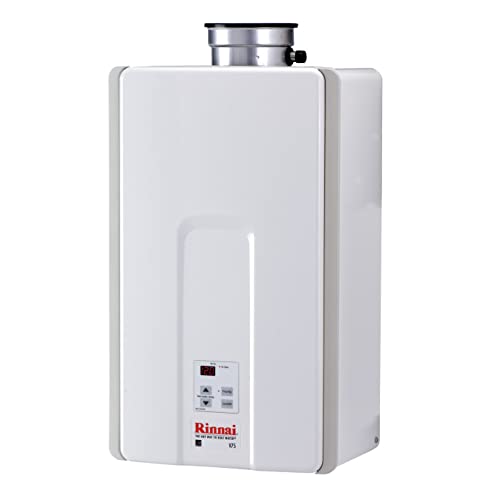
Rinnai V75IN offers 7.5 GPM of continuous hot water from a compact indoor natural gas unit. This non-condensing model is designed to fit tight spaces while delivering reliable on-demand heat for households that need multiple outlets simultaneously. Its compact size helps maximize living space, and performance maintains consistent water pressure across several fixtures. The V75IN emphasizes energy efficiency by heating water only when demanded, contributing to lower energy bills and less standby heat compared with traditional tanks.
Like other non-condensing models, proper venting and clearance are essential for optimal operation. Indoor installations should align with local codes and vent paths, while outdoor use may require weatherproofing. The V75IN provides a balanced combination of moderate GPM, compact footprint, and straightforward service—an accessible option for homes seeking dependable hot water without venting complexity.
Buying Guide
Gas Type And Venting
- Natural gas models offer broad availability in many regions; propane units are common where natural gas isn’t accessible. Both require proper venting to expel combustion gases safely. Non-condensing units vent exhaust at a higher temperature, which can simplify vent material choices but may require a dedicated vent run. Professional installation ensures correct vent sizing and clearance.
- Check whether your space supports a direct vent or power-vent approach and whether the system can be installed indoors in a dedicated utility area or in a protective enclosure for outdoor installations.
Flow Rate And Household Demand
- Estimate the maximum simultaneous hot-water demand in your home. A typical shower can draw around 2–2.5 GPM, a dishwasher about 1.5–2 GPM, and sinks about 0.5–1.5 GPM each. Add these values to choose a unit with adequate GPM capacity for your peak load.
- Lower-GPM models are often best for smaller homes or situations with fewer simultaneous hot-water users, while higher-GPM units support larger households and busy kitchens or baths.
Installation Considerations
- Indoor installations require space with proper clearance and venting. Outdoor units demand weather protection and sometimes additional venting components or protective housings. Location should minimize cold-water return losses and make maintenance accessible.
- Confirm that your space can accommodate required gas line sizing and vent runs. Improper gas sizing or venting can reduce heater efficiency and shorten component life.
Efficiency, Costs And Maintenance
- Non-condensing models typically have slightly lower operating efficiency than condensing units, but their upfront cost and simplicity can be favorable for many homes. Consider total operating costs over the life of the unit, not just upfront price.
- Periodic maintenance, including flushing and descaling when needed, helps sustain performance. Regularly inspect venting integrity and gas connections for safety and efficiency.
Warranty, Service And Smart Features
- Examine warranty coverage for heat exchangers, labor, and parts. Longer coverage can reduce long-term ownership risk. Some models support smart controllers or recirculation features that offer convenience and potential water savings.
- Evaluate compatibility with future smart-home integrations (ControlR or similar controls) and whether additional components (like a recirculation pump) are part of your desired setup.