Finding a dependable kerosene heater for a garage or workshop can be tricky. This guide highlights five top models designed to deliver rapid, consistent warmth in large spaces. Each option operates on kerosene (or compatible fuels) and features built-in safety measures and portable designs for job sites and garages. Use this overview to compare heat output, fuel flexibility, and utility features before choosing a heater that fits your workspace size and climate.
Summary of Selected Products
| Product | Brand | Fuel Type | BTU / Coverage | Approx. Run Time |
|---|---|---|---|---|
| Remington 80,000 BTU Kerosene/Diesel Heater | Remington | K-1 kerosene; #1 & #2 diesel; JP8/Jet A | 80,000 BTU | Up to 10 hours |
| VEVOR Kerosene Forced Air Heater | VEVOR | Kerosene and Diesel (one fuel at a time) | 215,000 BTU | Up to 8+ hours (depends on fuel) |
| Reddy Heater Forced Air Heater, 80,000 BTU | Reddy Heater | Kerosene; #1 & #2 fuel oil; diesel; JP8 | 80,000 BTU | Up to 8+ hours |
| Mr. Heater 140,000 BTU Forced Air | Mr. Heater | Kerosene-family fuels | 140,000 BTU | Up to 8 hours |
| BILT HARD 135,000 BTU Forced Air | BILT HARD | Multi-fuel: 2-K kerosene; #1 & #2 diesel | 135,000 BTU | Up to 8 hours |
Each model below is examined for heat output, fuel flexibility, safety features, and mobility to help a garage or workshop stay productive even in colder months.
Remington 80,000 BTU Kerosene/Diesel Heater
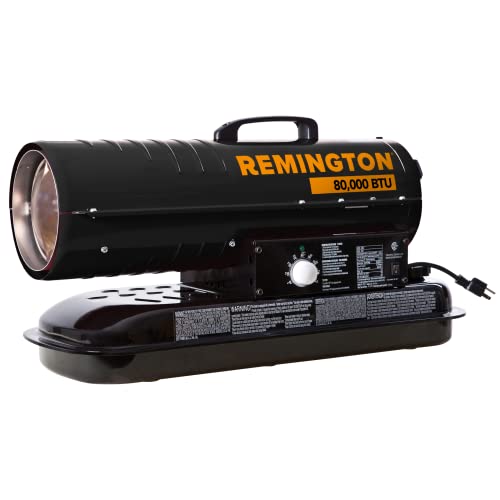
The Remington REM-80T-KFA-B is designed for spaces up to 2,000 square feet and can run for around ten hours on a full tank. It accepts multiple fuels including kerosene and various diesel fuels, offering flexibility in fuel availability. The model emphasizes safety through a five-point system, including a high-temperature limit switch, flameout protection, circuit breaker, heat sensor, and protective guards. This heater is suited for garages, warehouses, and larger workshops where steady heat is required.
VEVOR Kerosene Forced Air Heater

The VEVOR unit delivers 215,000 BTUs, capable of heating large spaces like barns, workshops, or garages up to substantial volumes. It uses kerosene or diesel fuels (one type at a time) and includes a thermostat, room temperature display, and an automatic shutoff feature when the set temperature is reached. A fuel gauge and dual fuel filters help monitor fuel and reduce odor, while safety features protect against overheating. This model suits sizable work areas requiring rapid, consistent heat.
Reddy Heater Forced Air Heater, 80,000 BTU

The Reddy Heater RFA80T provides 80,000 BTU suitable for heating about 2,000 square feet, making it apt for mid-size workshops and garages. It supports multiple fuels including kerosene, fuel oil, diesel, JP8, and jet fuel, delivering flexibility where fuel options vary by job site. A strong motor and broad heating area ensure rapid warmth distribution for workspaces that demand steady temperatures to preserve tools and materials.
Mr. Heater 140,000 BTU Forced Air Kerosene Heater

The Mr. Heater 140,000 BTU unit heats spaces up to 3,500 square feet and runs up to eight hours on a tank of kerosene. Its high-output performance makes it well-suited for larger garages, barns, and workshops that require quick warm-up and sustained heat. The model emphasizes straightforward fuel management and robust heat distribution for open areas or poorly insulated spaces.
BILT HARD 135,000 BTU Forced Air Heater

The BILT HARD unit offers 135,000 BTU of heat output with an eight-hour runtime on its eight-gallon fuel capacity. It is CSA certified for multi-fuel use, accepting 2-K kerosene or filtered diesel fuels, with a recommended 1-K kerosene for cleaner burn. The heater features portability with wheels and a pull handle and includes a protective frame to stabilize operation. This model is versatile for outdoor jobsites, garages, and construction sites where mobility matters.
Buying Guide: Key Purchase Considerations
When selecting a kerosene heater for a garage or workshop, consider space size, typical climate, and fuel accessibility. Look for the following factors to make an informed choice.
- Heat output and space coverage: Larger spaces require higher BTU ratings. For garages up to 2,000–3,500 square feet, consider heaters in the 80k–140k BTU range, and for bigger spaces, models exceeding 200k BTU may be necessary.
- Fuel flexibility: Multi-fuel options expand fuel availability during supply disruptions. Check whether one fuel type is used at a time to avoid cross-contamination and odor issues.
- Fuel economy and runtime: A larger tank or efficient combustion reduces frequent refueling. Consider models with clear fuel gauges and automatic shutoffs on low fuel or overheating.
- Safety features: Look for flameout protection, high-temperature limits, overheat protection, and sturdy guards. A wired or automatic shutoff on tipping or abnormal operation adds safety for garage environments.
- Portability and construction: Wheels, handles, and a robust steel frame help move heaters between work zones and protect against accidental bumps in busy spaces.
- Installation and ventilation: Ensure adequate ventilation to prevent carbon monoxide buildup. Follow manufacturer guidelines for clearances from walls, vehicles, and flammable materials.
- Maintenance: Regular inspections of fuel lines, filters, and the burn area extend the heater’s life. Some models require more frequent maintenance due to higher output.
- Noise and odor: Some high-output units can be noisy or emit noticeable odor during operation. Consider models with mufflers or better fuel filtration if noise is a concern.
- Smart features: WiFi/Bluetooth monitoring, thermostats, and remote controls offer convenience for controlled heating without staying close to the unit.
In choosing a kerosene heater for a garage, evaluate your space, climate, and workflow. A higher BTU model provides faster warm-up in open layouts, while a multi-fuel design ensures fuel options remain flexible in varying conditions. Safety, portability, and fuel management are equally important for long-term reliability in workshop environments.