Answer: For accurate, at-home water hardness testing, use a dedicated hard water test kit that delivers clear results fast. These picks suit homeowners with hard water concerns, renters checking tap water quality, pool and spa owners, and households monitoring appliance health. This guide highlights top kits, showing who benefits most from each option and why they stand out for simple, reliable testing at home.
Summary of selected products
| Product | Brand | Key Benefit | Best For |
|---|---|---|---|
| Varify Water Hardness Test Kit | VARIFY | Fast dip-and-read results with a large color chart | Quick home checks for whole-house water and appliances |
| Water Hardness Test Kit by JNW Direct | JNW Direct | Versatile testing for multiple water sources | Homes with wells, filtered systems, and dishwashers |
| Water Hardness Test Kit (150 Strips) by Merydi | Merydi | Double-color pads for improved accuracy | Regular monitoring of hardness in taps, softeners, and pools |
| WeAQUA DoubleCheck Water Hardness Test Kit | WEAQUA | Two identical color pads per strip for reliability | Users who want redundancy to verify results |
| Hach Total Hardness Test Kit, Model 5-B | Hach Company | Drop-count titration with familiar testing method | Researchers, hobbyists, and serious hobbyist testing |
Varify Water Hardness Test Kit

Varify’s kit offers a quick dip-and-read approach to determine hardness levels from 0-425 ppm and 0-25 gpg. It’s best for households seeking fast, actionable results for whole-home water and for checking specific sources like drinking water, pools, or appliances. The oversized color chart simplifies interpretation, aiding accuracy for all ages.
Who this is best for: homeowners who want a straightforward, fast test and easy-to-interpret results for common home uses. Better for quick checks than deep laboratory-style analysis. Caution: color interpretation can vary slightly under different lighting; ensure adequate lighting when reading the chart.
Water Hardness Test Kit by JNW Direct

JNW Direct’s kit tests hardness across home faucets, well water, softeners, dishwashers, and more, making it versatile for households with multiple water sources. It’s quick and provides clear color-chart results, helping determine whether a water softener is functioning properly or if additional treatment is needed.
Who this is best for: households with varied water sources or those who want to monitor softener performance. Choose this if you need a broad applicability kit. Limitation: results rely on color matching; ensure good lighting to read the chart accurately.
Water Hardness Test Kit, 150 Strips by Merydi

Merydi uses double-color pads on each strip to improve accuracy by cross-checking color results. The set includes 150 strips and a test tube, suitable for ongoing monitoring of hardness in home water supplies, softeners, and spa/pool water. The double-pad design helps reduce false readings due to defective pads.
Who this is best for: buyers who value redundancy and more robust accuracy in repeated use. Better for long-term monitoring rather than a single quick check. Caution: ensure used strips are read within the recommended time window for the most accurate color comparison.
WeAQUA DoubleCheck Water Hardness Test Kit
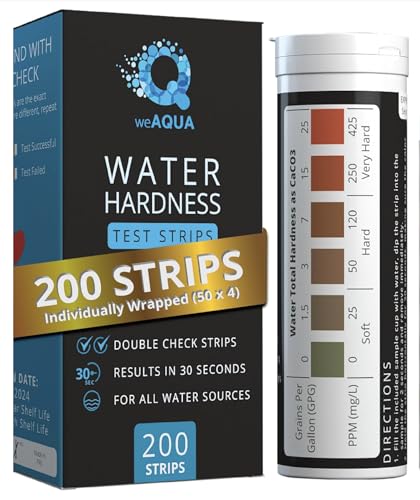
WeAQUA emphasizes reliability with double identical color pads on each strip and a supplied sample cup to standardize readings. The kit includes 200 strips at a low cost per test, making it a value-oriented choice for those who test regularly and want to minimize sampling errors.
Who this is best for: budget-conscious buyers who test frequently and appreciate built-in verification. Limitation: reading requires matching two pads; if results differ, re-test to confirm consistency.
Hach Total Hardness Test Kit, Model 5-B

Hach’s Total Hardness Test Kit uses a drop-count titration method to measure hardness as CaCO3, within a range of 1-30 gpg. It includes essential components for field and lab-style testing and is designed for users who prefer a traditional, economical titration approach with repeatable results.
Who this is best for: individuals who value a proven, classic titration method and perhaps want to align with standard testing practices used in labs. Limitation: may require careful handling of reagents and precise drop counts for accurate results.
Buying Guide: How to Choose the Right Home Water Hardness Test Kit
- What water source will you test most often? (Tap, well, spa, pool, or drinking water) Choose a kit with demonstrated versatility for your primary source.
- How often will you test? If you test regularly, consider kits with 150–200 strips or refill options to reduce ongoing costs.
- Do you need redundancy or cross-checks? Some kits, like DoubleCheck or dual-pad strips, improve reliability for repeat measurements.
- What reading format do you prefer? Color charts are quick; titration methods offer a traditional approach but may require more steps.
- Is budget a major factor? Look for value-packed kits with many tests per box, but ensure accuracy remains high.
- How important is ease of use? Look for dip-and-read designs with clear instructions and large, easy-to-interpret color scales.
- What is your preferred level of detail? Some kits report in ppm and gpg; others focus on simple “soft/medium/hard” categories.
Practical Tips for Getting Consistent Results
- Test water at a consistent temperature and in a clean, uncontaminated container.
- Read results promptly within the manufacturers’ recommended time window.
- Keep strips sealed and stored as advised to avoid deterioration.
- Use the same kit for longitudinal testing to ensure comparability across tests.
Common Scenarios and Recommended Kits
- Quick home checks after plumbing work or new appliances: Varify or JNW Direct offer fast, user-friendly readings.
- Well-water monitoring and periodic softener checks: JNW Direct or Merydi provide broad applicability and accuracy.
- Frequent testing with high-volume needs: WeAQUA DoubleCheck delivers many tests with redundancy.
- Preference for traditional titration methods: Hach Total Hardness Kit is suitable for those who favor classic titration.
FAQ
What does “hardness” mean in water?
Hardness measures mainly calcium and magnesium ions in water, which can affect appliances, pipes, and soap performance.
How do I know which unit to read, ppm or gpg?
Both are common. ppm typically equals milligrams per liter (mg/L). 1 gpg equals 0.056 g/L, and 1 gpg equals 17.1 mg/L.
How often should I test my water hardness?
Test when you notice scale buildup, after installing a water softener, or when evaluating appliance performance and efficiency.
Can these tests detect other contaminants?
Most tests focus on hardness; some kits also test for additional parameters like chlorine or iron, depending on the kit.
Do I need professional lab testing for hardness?
Home test kits provide quick, actionable readings. For formal compliance or detailed analysis, professional lab testing may be recommended.