Front door keyless entry locks offer convenient, secure access without carrying physical keys. This guide highlights five top options, explaining who they’re best for and why. Ideal for busy households, remote work, and homes needing flexible access for guests or service providers, these locks differ in connectivity, voice control, and installation ease. The summary below helps compare features at a glance so you can choose confidently.
| Product | Brand | Key Strengths | Best For |
|---|---|---|---|
| TEEO Satin Nickel TE001 Keyless Entry Door Lock | TEEHO | 20 code entries, One-Time Code, auto-lock | Families needing simple keypad access |
| Philips WiFi Keypad Door Lock with Handle | Philips | Direct WiFi, remote app control, voice assist | Remote monitoring and hands-free control |
| Philips Wi-Fi Door Lock with Built-in WiFi | Philips | 2.4GHz WiFi, app control, voice control | Smart home integrators and multi-user setups |
| Schlage Camelot Electronic Keypad Deadbolt | SCHLAGE | 2 pre-programmed codes, up to 19 codes, battery alert | New to keyless entry with clear, strong security |
| Veise VE017G-H Wi-Fi Smart Fingerprint Lock | Veise | WiFi control, fingerprint, 8-in-1 access | Tech-forward homes needing biometric access |
Note: All five selections emphasize ease of use and clear, direct access control. The following sections break down each product’s fit, limitations, and what makes them stand out for different buyers.
TEEO Satin Nickel TE001 Keyless Entry Lock

This keypad lock supports 20 access codes for family use and a temporary one-time code for guests. It includes auto-lock options and a 2-second hold to lock from the keypad. Best for households preferring keypad entry without hubs or apps. The one-time code feature reduces the risk of sharing codes long-term. A potential limitation is the lack of remote access without additional hardware.
Who it’s best for: Families seeking straightforward keypad entry with temporary guest access and simple installation.
Why this one was selected: It balances practical keypad features with automatic locking while staying easy to install on most standard doors.
Limitations to consider: No built-in WiFi or app control; may require manual operation if you want remote access later.
Philips WiFi Keypad Door Lock With Handle
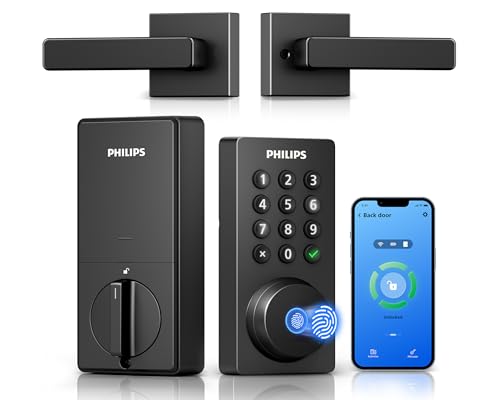
This lock features built-in 2.4GHz WiFi and direct app control. It supports remote access, code and fingerprint management, and real-time status checks. Voice assistant compatibility with Alexa or Google Assistant adds hands-free convenience. It’s best for homeowners who want remote monitoring without a hub and want voice control. Note that it requires a stable 2.4GHz network for optimal performance.
Who it’s best for: Tech-savvy homeowners who want remote locking/unlocking and voice control without extra hubs.
Why this one was selected: Strong remote control capabilities combined with easy app management and voice integration.
Limitations to consider: Requires 2.4GHz WiFi and stable network; not ideal for 5GHz networks or unstable connections.
Philips Wi-Fi Door Lock, Built-in WiFi

Offers flexible unlock methods, including app control, passcodes, fingerprints, and voice via Alexa/Google Assistant. The lock supports remote control and requires a 2.4GHz network. It’s a practical option for households that want multiple access methods and family-wide code sharing. The system notes that the router should be within about 65 feet for reliable remote control.
Who it’s best for: Families needing flexible access options and voice command control.
Why this one was selected: Multi-access methods and remote operation make it versatile for varying daily routines.
Limitations to consider: Requires compatible 2.4GHz network and stable connectivity for best performance.
Schlage Camelot Electronic Keypad Deadbolt

This keypad deadbolt supports two pre-programmed codes out of the box and up to 19 codes overall. It uses a battery-powered deadbolt with a low-battery indicator, offering up to two years of typical battery life. It’s a reliable, traditional keypad option with strong physical security and a straightforward setup. Best for those who want a simple, no-hub keypad solution with clear battery indicators.
Who it’s best for: Users who prefer a trusted, straightforward keypad with mechanical backup considerations.
Why this one was selected: Combines familiar keypad convenience with solid durability and clear battery monitoring.
Limitations to consider: Mechanical backup is included, but no built-in wireless connectivity beyond keypad codes.
Veise VE017G-H Wi-Fi Smart Fingerprint Lock

This 8-in-1 lock combines fingerprint, keypad, app control, voice control, codes, cards, backup key, and user authorization. It includes a WiFi gateway to enable remote control and extends to support multiple management features via the Veise app. It’s best for households wanting biometric access and broad, flexible user management. A potential limitation is reliance on app-based access administration and network stability for remote use.
Who it’s best for: Homes needing multiple access methods with biometric entry and remote management.
Why this one was selected: Offers the richest combination of access methods and remote admin features among the options.
Limitations to consider: More complex setup; requires WiFi gateway for full remote features.
Buying Guide: Key Considerations When Choosing a Front Door Keyless Lock
- : Do you want a standalone keypad, or is built-in WiFi and app control essential? If you want remote access, choose models with direct WiFi or hub-free smart integrations.
- : Are codes enough, or do you want biometrics (fingerprint), voice control, or card entry as well? Consider households with children or visitors for guest codes.
- : Look for low-battery indicators, tamper alerts, and strong construction. Grade or security ratings can guide durability expectations for residential use.
- : Some locks are designed for easy retrofit on standard doors; others may require drilling or compatibility checks with backset and bore sizes. Measure your door first.
- : If multiple people access the door, consider how easily you can add, delete, or schedule access codes and permissions. Biometric and app-based management often simplify this.
- : Battery life varies; check replacement intervals and whether the unit supports emergency physical keys in case of power loss.
- : If you use Alexa or Google Assistant, verify supported features and app integration for hands-free control.
- : For exterior doors, ensure the lock is weather-rated and corrosion resistant to handle humidity and temperature changes.
Frequently Asked Questions
- Do keyless door locks require a WiFi connection to work? Some operate locally via keypad or Bluetooth; others rely on WiFi or a hub for remote access and app control.
- Is biometric access secure for front doors? Fingerprint sensing adds convenience but may require occasional cleaning and calibration; pair with codes or keys for backup.
- Can I install these locks myself? Most models are designed for DIY installation on standard doors, but some may require professional help for extended backsets or unusual door preps.
- What happens if the lock battery dies? Many models include a mechanical key backup or low-battery alerts to prevent lockouts.
- Will these locks work with my existing smart home? Check compatibility with your chosen voice assistants and whether a hub-free design exists for your setup.
- Are these locks weatherproof for exterior doors? Look for weather-rated or IP-rated locks designed for outdoor use; not all models are suited for harsh conditions.