When shopping for a combination door lock with a deadbolt, you want reliability, easy user management, and strong security. This guide highlights five top options that balance convenience and safety for American homes. Best for busy households, rentals, or homes with frequent guests, these models provide keypad access, time-limited codes, and auto-lock features. The following table compares key details to help you decide quickly.
| Product | Brand | Key Features |
|---|---|---|
| TEEHO TE001 Satin Nickel | TEEHO | 20 codes, one-time code, auto-lock, 2-second hold to lock |
| TEEHO TE001 Oil-Rubbed Bronze | TEEHO | 20 codes, one-time code, auto-lock, 2-second hold to lock |
| Veise Keyless Entry With 2 Knobs Satin Nickel | Veise | 20 codes, master + backup keys, auto-lock, anti-peep |
| Kwikset Powerbolt 250 Satin Nickel | Kwikset | Up to 25 user codes, 5 one-time codes, auto-lock |
| Schlage Camelot BE365 Satin Nickel | SCHLAGE | Pre-programmed codes, up to 19 codes, low-battery indicator |
TEEHO TE001 Satin Nickel Keypad Deadbolt

Best for: Households needing a straightforward keypad option with reliable auto-lock. The TE001 offers 20 codes for family use and a one-time code for guests, making it suitable for daily family access or short-term rentals. The auto-lock feature enhances security after entry. Choose this if you want simple installation and a clean satin finish that fits modern doors.
Why selected: It provides essential access control without extra frills, and its one-time code capability reduces guest-key handling. The 2-second auto-lock push is a quick, secure option for busy households.
Caution: Some users may want advanced smart-home integrations not offered by this model; no Wi-Fi or Bluetooth connectivity is included.
TEEHO TE001 Oil-Rubbed Bronze
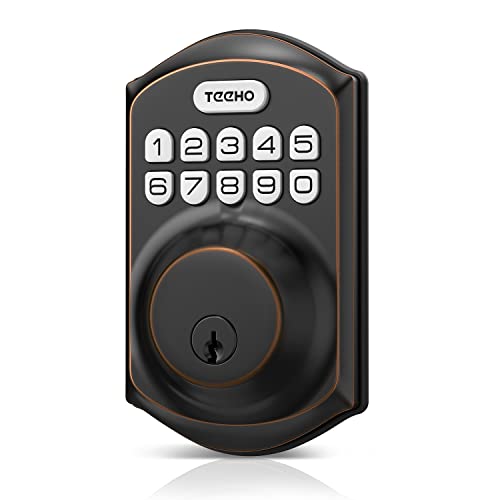
Best for: Homes with a traditional or rustic aesthetic that matches an oil-rubbed bronze finish. The keyless keypad simplifies access for multiple residents while preserving a classic look.
Why selected: It mirrors the Satin Nickel model’s core features in a bronze finish, giving design flexibility and consistent security options across door styles.
Caution: Finish tone may vary slightly with lighting; verify color alignment with your door hardware before purchase.
Veise Satin Nickel 2-Knob Keyless Entry

Best for: Families with frequent visitors or service workers. It supports up to 20 user codes, plus a master code and two backup keys, making it flexible for multiple households or tenant scenarios. Anti-peep protection adds privacy during code entry.
Why selected: The multiple-layer access system and anti-peep protection enhance daily usability and security in households with varied access needs.
Caution: The model includes both keypad and lever mechanisms; some users may prefer purely deadbolt systems for minimal hardware footprint.
Kwikset Powerbolt 250 Satin Nickel

Best for: Homeowners who want extensive code customization and flexible auto-lock timing. It supports up to 25 user codes plus multiple one-time codes, and lets you choose auto-lock timing from 30 seconds to 10 minutes.
Why selected: The broad code-management options make it adaptable for families, roommates, or short-term rental scenarios, while the auto-lock feature provides consistent security.
Caution: Routine maintenance of the battery is essential to prevent lockouts; low-battery alerts are helpful but require monitoring.
Schlage Camelot BE365 Satin Nickel

Best for: Homes needing a trusted brand with long-standing security reputation and a mechanical key backup. The BE365 supports up to 19 codes and includes a low-battery indicator for proactive maintenance.
Why selected: Schlage is a durable option with straightforward installation and a robust backup key system, making it suitable for traditional doors and those seeking a familiar brand.
Caution: The battery-powered operation requires occasional battery changes; consider a backup access plan for power outages or dead batteries.
Buying Guide
What should you consider when choosing a combination lock with a deadbolt?
- Access control needs: Do you need many user codes, one-time guest codes, or both? Choose a model that matches your household size and guest frequency.
- Auto-lock timing: Decide how quickly you want the door to lock after closing. Shorter intervals increase security but may be less convenient if you frequently forget to re-lock.
- Finish and style: Match the lock finish (satin nickel, oil-rubbed bronze, matte black) to your door and existing hardware for a cohesive look.
- Key backup: Some models include physical keys or master codes. Consider whether you need a traditional backup method in case the keypad is unavailable.
- Security features: Anti-peep or obfuscation codes help protect against smudge and code-guessing attacks. Look for tamper resistance and lockout features after incorrect attempts.
- Power source: Ensure you’re comfortable with battery changes and potential power concerns. Some models provide low-battery indicators to prevent lockouts.
- Compatibility: Verify backset, door thickness, and bore size to ensure a proper fit and easy installation on your door.
FAQ
- What is a one-time code and why is it useful?
A one-time code is a temporary PIN that works for a single entry and then automatically expires, making it ideal for guests or service workers. - Can these locks be used on any front door?
Most are designed for standard residential doors but always check backset and thickness specifications before installation. - Do these locks require Wi-Fi or a smartphone app?
The models listed are keypad-based and offline; they do not require Wi-Fi or an app for operation unless specified otherwise by the manufacturer. - How long do batteries typically last?
Battery life varies by model and usage, with battery indicators helping you plan replacements before lockouts occur. - Is there a recommended brand for long-term reliability?
Brands like Schlage and Kwikset have longstanding reputations for residential hardware, though each model’s features should align with your needs. - What maintenance is needed for best performance?
Regular battery checks, cleaning of keypad contact points, and updating access codes when members change help maintain security.