Basement home gym flooring that protects your floors and cushions impact is essential for safe, effective workouts. This guide highlights five top options that balance protection, comfort, and price. Each choice fits different basement layouts and equipment, so you can pick the best match for your space and routine.
Buyer types covered: beginners building a basic workout area benefit from affordable puzzle mats; renters or short-term setups may prefer modular, easy-to-reconfigure options; serious home gyms with heavy equipment benefit from dual-layer mats with durable surfaces. The table below summarizes the selected products to help you compare at a glance.
| Product | Size / Coverage | Best For | Why It Stands Out |
|---|---|---|---|
| ProsourceFit Puzzle Mat ½” (48 sq ft) – 12 Tiles | 48 sq ft | Budget-friendly basics | Lightweight EVA foam, easy to install, cushions floors while protecting carpet or concrete |
| ProsourceFit Puzzle Mat ½” (144 sq ft) – 36 Tiles | 144 sq ft | Medium to larger spaces | More coverage with the same great features; scalable for bigger basements |
| BeMaxx Gym Mats Set – 18 pcs | 18 tiles, 18 sq ft | High protection for busy spaces | Edge pieces for complete coverage; BPA-free; durable EVA foam with anti-slip surface |
| AIRHOP 0.56″ Thick – 48 Sq Ft | 48 sq ft | Heavy equipment and varied workouts | Dual-layer design with rubber top for traction and shock absorption |
| SUPERJARE 0.56″ Thick – 48 Sq Ft | 48 sq ft | Quiet workouts with heavy gear | Dual-layer EVA foam with rubber top; strong grip and reduced noise |
ProsourceFit Puzzle Mat ½” 48 Sq Ft—12 Tiles

Product overview: ProsourceFit Puzzle Mat ½-inch EVA interlocking foam floor tiles designed for home gyms, workout equipment rooms, and kids play areas. Comes in a 48 square foot set (12 tiles). The high-density EVA foam provides cushioning and support, creating a comfortable workout surface while protecting underlying floors. The mat is water-resistant and easy to clean, and it adapts well to flat, hard surfaces.
- Best for: small to medium basement spaces needing simple protection and cushioning.
- Why selected: Easy install, lightweight, and cost-effective for foundational flooring.
- Caution: Color and texture may vary slightly by batch; not ideal for extremely uneven substrates without additional leveling.
ProsourceFit Puzzle Mat ½” 144 Sq Ft—36 Tiles
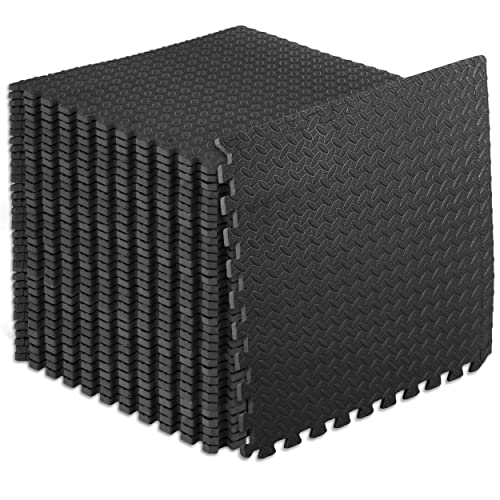
Product overview: An expanded version of the ProsourceFit puzzle mats, offering 144 square feet of protective surface with 36 interlocking tiles. Provides a larger continuous cushioned area ideal for home gyms with multiple machines or free weights.
- Best for: basements with more floor area or home gyms that require seamless coverage under several pieces of equipment.
- Why selected: Scales up protection and comfort without complex installation.
- Caution: As with smaller sets, batch variation can affect color and texture slightly.
BeMaxx Gym Mats Set — 18 Pcs

Product overview: BeMaxx 18-piece EVA interlocking foam tiles with edge pieces for a complete floor protection system. The mats are BPA-free, made from high-density EVA foam with an anti-slip surface, suitable for fitness spaces, garages, basements, and playrooms.
- Best for: renters or homeowners needing edge-to-edge coverage on irregular layouts.
- Why selected: Fully modular with edge pieces for a clean, gap-free floor; good durability for a basement setting.
- Caution: Some users may prefer slightly thicker thickness for heavier equipment beyond basic workouts.
AIRHOP 0.56″ Thick 48 Sq Ft Mats

Product overview: AIRHOP 0.56-inch thick mats feature a dual-layer design with a rubber top and high-density EVA foam bottom. The 12 tiles cover 48 square feet, with upgraded interlocking locks to prevent shifting during workouts. Built to withstand heavy equipment while offering solid shock absorption.
- Best for: basements with heavier gym machines and weights needing robust floor protection.
- Why selected: Dual-layer construction enhances durability and traction; simple assembly.
- Caution: Rubber top may have residual odor in some environments; ensure ventilation after unboxing.
SUPERJARE 0.4″ Thick 24 Pcs—96 Sq Ft

Product overview: SUPERJARE’s 0.4-inch thick, 24-piece set delivers 96 square feet of cushioned surface with a rubber top and EVA foam base. The dual-layer design aims for strong weight compatibility, reduced noise, and stable footing during lifts and cardio.
- Best for: larger basement areas needing more extensive coverage with quieter operation.
- Why selected: Notable balance of grip, cushion, and noise reduction for multi-use home gyms.
- Caution: Slightly thinner core than some competitors; ensure your equipment distribution matches the surface capabilities.
PRAISUN 0.56″ Rubber Top Gym Flooring

Product overview: PRAISUN 0.56-inch thick gym flooring combines a high-density EVA foam core with a durable EPDM rubber top. The 24 x 24-inch panels offer 48 square feet of protection, designed to handle heavy weights and equipment while reducing floor impact and noise.
- Best for: basements with weight racks, benches, and machines that require durable top protection.
- Why selected: Strong dual-layer design provides balance of grip and cushioning suitable for intense workouts.
- Caution: Rubber top can have odor initially; ensure adequate airing before use in tight spaces.
Buying Guide: Choosing Basement Gym Flooring
Key considerations help match flooring to your space and workout needs. Use these practical questions to compare options.
- What space do I have? Measure your basement area and consider future expansion. Puzzle mats scale well, but larger spaces may benefit from modular panels that cover broad zones with fewer gaps.
- What equipment will I use? Heavier equipment demands durable surfaces with strong edge stability. Dual-layer mats with rubber tops tend to withstand heavier loads and reduce vibrations.
- Do I need noise reduction? If upstairs living areas are nearby, prioritize cushioning and quiet operation to minimize disturbance.
- Is setup temporary or permanent? Interlocking tiles offer quick assembly and relocation, ideal for renters or changing layouts.
- What about cleanliness and maintenance? Water-resistant surfaces with easy-to-clean textures save time and keep spaces hygienic.
- What thickness is right? Thicker mats (around 0.56 inches) provide better impact absorption, especially for lifting or plyometric movements.
- Do I prioritize cost or coverage? Smaller sets are budget-friendly, while larger sets give more seamless protection and reduce gaps under larger equipment.
Frequently Asked Questions
- What is the main difference between EVA foam mats and rubber-top mats?
EVA foam mats are lightweight, cushiony, and easy to cut or reconfigure, while rubber-top mats offer higher durability, better traction, and stronger weight-bearing capacity. - Are puzzle mats good for heavy gym equipment?
They work for many home gym setups, but for heavy weights or machines, consider dual-layer mats with a rubber top to ensure stability and longevity. - How thick should basement gym flooring be?
A thickness of 0.56 inches provides strong shock absorption and equipment support for most home gym activities; 0.4 inches is lighter but adequate for lighter use and cardio-only spaces. - Can I install gym flooring over carpet?
Yes, flat, hard surfaces are ideal. If the basement floor is uneven, level patches or choose mats that tolerate minor irregularities. - How do I maintain gym mats?
Wipe with a mild soap solution, rinse, and air dry. Avoid abrasive cleaners that could degrade the surface. - Do mats eliminate all noise?
They reduce noise and vibration, but some sound may still transfer through the floor depending on construction and equipment used.