Answer: Perforated flex drain pipes are ideal for French drains and landscape drainage projects where you need flexible, expandable piping that can handle groundwater dispersion. These pipes are best suited for homeowners tackling yard drainage, garden bed runoff, or gravel-filled drainage trenches. The top picks below are chosen for durability, ease of use, and perforation design that promotes even water distribution along the length of the pipe. The buyer can expect straightforward installation, resilience in varying soils, and clear indicators of suitability for coarse or fine soil conditions.
Overview: The following five products represent solid perforated or solid flex drainage options commonly used in landscape projects. The quick-reference table highlights intended use, diameter, and expansion behavior to help you compare at a glance.
| Product | Diameter | Length | Perforated | Best For |
|---|---|---|---|---|
| Flex-Drain 51310 | 4 Inches | 25 Feet | Yes | General yard drainage with even perforations |
| Flex-Drain 51110 | 4 Inches | 25 Feet | No | Solid drainage where a non-perforated pipe is preferred |
| Flex-Drain 54022 | 4 Inches | 8 Feet | Yes | Compact trenches with full-length perforations |
| 212 Main 4in Perforated | 4 Inches | 25 Feet | Yes | Groundwater drainage in French drains |
| Flex-Drain 51910 | 4 Inches | 12 Feet | Yes | Longer runs with perforations for soil dispersal |
Note: If you plan to discharge water at the end of the run, consider perforated options like Flex-Drain 54022 or 51310 for even distribution along the length. For simpler, straight-through drainage, solid options like Flex-Drain 51110 provide a robust core with fewer joints. The following sections detail each pick with usage scenarios, pros, and any practical limits to consider.
Flex-Drain 51310 Perforated Drain Pipe, 4-Inch by 25-Feet

The Flex-Drain 51310 is a flexible, expandable perforated drain pipe designed for general landscape drainage. It expands to a full 25 feet and is perforated along its length to disperse water. Best for yards, flower beds, and gravel-filled trenches where even moisture distribution is needed. It is marketed as highly durable and easy to use, making it a practical choice for DIY installations. A potential limitation is that the product’s perforations require proper backfill and slope to achieve optimal water movement.
Flex-Drain 51110 Solid Drain Pipe, 4-Inch by 25-Feet

The Flex-Drain 51110 is a solid, expandable drainage pipe suitable for scenarios where you need a durable, non-perforated conduit. It unfolds and expands reliably and is noted for value and ease of use. Best for long, uninterrupted drainage runs where soil conditions favor a solid conduit. A caution: perforated sections are not included, so this is not ideal for dispersing surface water along the trench unless paired with additional filtering or a separate perforated liner.
Flex-Drain 54022 Perforated Drain Pipe, 4-Inch by 8-Feet

The 54022 model features perforations along the full length to drain a wide area and discharge at the pipe end. It combines advanced design with robust perforation work to keep soil moisture balanced. Best for medium to large drainage areas where a uniform release pattern is preferred. A limitation to consider: the eight-foot length may require multiple segments for longer runs, potentially increasing joints.
212 Main Plastic Perforated Flexible Drain Pipe, Black, 4×25

The 212 Main perforated pipe is designed for groundwater drainage with a 2-to-25-foot expandable length. It is framed as a French drain-friendly option that exceeds applicable ASTM standards. Best for retrofits or projects requiring a highly adaptable pipe that can cover irregular trench lengths. A practical caution is ensuring the perforations match your soil’s permeability, as overly aggressive perforations can clog with fine soils.
Flex-Drain 51910 Perforated Drain Pipe, 4-Inch by 12-Feet
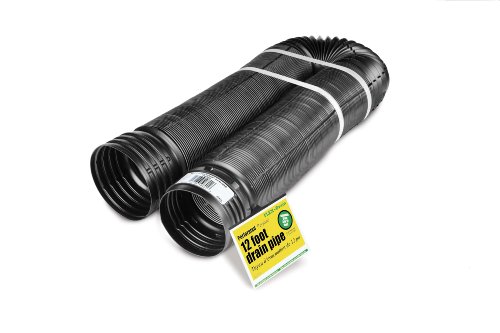
The 51910 model offers perforated drainage with expansion from 15 inches to 12 feet. This combination makes it suitable for longer, flexible runs in garden beds or yard trenches with gravel backfill. It’s best for situations where soil is coarse and water needs to disperse steadily along the trench. A caveat: the larger expansion range may require careful handling during installation to maintain a true trench slope.
Buying Guide: Key Considerations for Perforated Flex Drain Pipes
What should you evaluate before purchasing a perforated flex drain pipe?
- Drainage area size: For larger landscapes, longer perforated runs (like 25 feet) reduce the number of joints and potential failure points.
- Perforation pattern: Uniform perforations help distribute water evenly; avoid overly dense perforations in fine soils unless backfilling is designed to accommodate it.
- Soil type: Coarse soil benefits from perforated pipes that disperse water slowly, while fine soils may clog if perforations are too large.
- Pipe diameter: A 4-inch diameter is standard for many residential projects and balances flow with trench space.
- Expansion and flexibility: Expandable pipes simplify installation in long trenches but require careful handling to avoid kinks.
- Backfill and slope: Proper backfill with gravel or filter fabric and a consistent slope toward the outlet ensures efficient drainage.
Common installation questions
- Do perforated pipes require a filter fabric? Yes, to prevent sediment intrusion and maintain flow capacity.
- Should perforated pipes be laid with the perforations facing down or up? Perforations are typically oriented to maximize contact with surrounding soil for infiltration, though many designs are robust to either orientation when backfilled properly.
- Can I reuse solid pipe segments with perforated segments? Yes, but ensure proper configuration for the intended drainage path and avoid unnecessary joints in high-flow areas.
- What backfill materials work best? Clean gravel or crushed stone backing helps maintain flow and reduces clogging risk.
- How do I determine the correct slope? A common guideline is a 1% slope (one inch per 100 inches) toward the outlet, adjusted for local soil and water load.
Installation tips for accuracy and longevity
- Plan trench depth to accommodate backfill while maintaining outlet height above groundwater or standing water levels.
- Test-fit pipe runs before final placement to verify lengths and expansions align with trench geometry.
- Seal and protect joints in exposed areas to reduce the risk of infiltration from above-grade water or pests.
- Label sections clearly to simplify future maintenance or expansion projects.
What makes a perforated flex drain pipe a good value?
Durability, ease of use, and adaptability contribute to overall value. Expandable pipes reduce manual cutting and fit irregular trenches, while perforations enable efficient soil-based water dispersion. The best options balance a reasonable price, straightforward installation, and reliable performance across common landscape drainage challenges.
FAQ
- What is the main advantage of perforated versus solid flex drain pipes? Perforated pipes distribute water along their length, which is useful for French drains and broad drainage areas, while solid pipes provide a straightforward conduit for directed flow.
- Can perforated pipes be used in all soil types? They work well in many soils but may require backfill adjustments and filter fabric to prevent clogging in finer soils.
- How long should a perforated drain pipe run be for a typical yard? Runs of 15–25 feet are common for residential projects, though trench length and slope will influence this choice.
- Is one brand or model clearly superior? All five options shown are designed for durability and ease of use; the best pick depends on perforation needs, run length, and whether a solid or perforated design is required.
- Do I need professional help for installation? Simple, small projects can be DIY with careful planning; larger or complicated drainage systems may benefit from professional assessment.
- How do I maintain a perforated drain pipe over time? Use proper backfill, ensure no clogging at perforations, and periodically inspect for silt buildup or joint leaks after heavy rain.